The Real Benefits of Edging for Stamina and Control
Edging can genuinely improve ejaculatory control, extend sexual stamina, and in many cases make orgasms feel more intense. The evidence behind it is not hype. It is grounded in how arousal, blood flow, and the pelvic floor interact when stimulation is paused rather than pushed straight through.
- Physical gains: longer-lasting sex, stronger orgasms, and closer coordination with the pelvic floor.
- Mental and relational gains: more confidence, less performance anxiety, and better communication with a partner.
One caveat before anything else: edging should always happen with consent, it should never involve real pain, and anyone with persistent control problems deserves an actual conversation with a clinician, not just more practice.
Key Takeaways
Edging improves ejaculatory control and sexual stamina primarily by training recognition of the point of inevitability, with pelvic floor engagement and consistent, consent-based practice determining how well those gains transfer to partnered sex.
| Point | Details |
|---|---|
| Core mechanism | Recognizing and backing off before the point of inevitability builds control over time. |
| Physical benefit | Prolonged arousal and pelvic blood flow can make the eventual orgasm feel more intense. |
| Psychological benefit | Shifting from performance mindset to mindfulness reduces anxiety and builds confidence. |
| Safety reminder | Stop for real pain, and always practice with clear consent when a partner is involved. |
| Consistency matters | Structured, paced daily practice tends to outperform occasional long sessions. |
Table of Contents
- What Are the Main Benefits of Edging?
- How Does Edging Actually Change the Body?
- Does Edging Improve Confidence and Communication?
- Who Benefits Most From Edging, and Who Should Be Careful?
- How Do You Practice Edging Safely?
- What Are the Risks of Edging?
- How Does Structured Practice Improve These Results?
- Where Did Edging Come From?
- What Does the Research Say About Edging?
- How Does Edging Compare to Other Techniques?
- Does Edging Work the Same for Every Relationship?
- An Editorial Take on Structured, Evidence-Aligned Practice
- Sources
- FAQ
What Are the Main Benefits of Edging?
Most people trying edging for the first time are chasing one of four outcomes, and it helps to know which one applies to you.
- A more intense orgasm. Prolonging arousal before release increases pelvic blood flow, and the International Society for Sexual Medicine notes this buildup can make the eventual climax feel considerably stronger.
- Longer sexual stamina. Repeatedly approaching high arousal and backing off trains you to stay in that zone longer without losing composure, which is the whole point for anyone who wants sex to last.
- Better ejaculatory control. This is the biggest one for men dealing with premature ejaculation. Clinical guidance from Medical News Today describes edging as a legitimate way to delay ejaculation and intensify the eventual release, when practiced consistently.
- Sharper body awareness. You learn your own arousal curve. That awareness carries into the pelvic floor, where engaging the right muscles at the right moment becomes second nature rather than a guess.
None of this requires hours of practice. It requires attention. The gains show up faster for people who track what their body is actually doing in the moment, rather than treating edging as one more thing to power through.
How Does Edging Actually Change the Body?
Edging works because arousal is not a light switch. It is a slow climb, and what happens along that climb determines how much control you end up with.
- Blood flow rises with sustained stimulation. The longer arousal is maintained without release, the more pelvic vasocongestion builds, which is part of why the eventual orgasm can feel more powerful.
- The pelvic floor does real work here. These are the same muscles trained through Kegels, and pelvic floor strength correlates with better sexual function generally, not just during edging.
- The point of inevitability is the whole game. Healthline’s overview of orgasm control describes this as the exact moment ejaculation becomes involuntary. Backing off stimulation just before that threshold, rather than trying to override it, is what separates edging from simply losing control late.
Learning to recognize that threshold early is a skill. It gets sharper with repetition, and it is the mechanical reason stop-start practice works at all.
Does Edging Improve Confidence and Communication?
The physical gains get most of the attention, but the psychological shift is often what people notice first.
Practicing edging tends to move sex away from a performance mindset and toward something closer to mindfulness. You are paying attention to sensation instead of monitoring yourself for failure, and that shift alone can meaningfully reduce performance anxiety.
- Confidence builds through repetition. Each time you successfully recognize and manage arousal, you prove to yourself that you have some say in the outcome. That is a different feeling than hoping for the best.
- Anxiety tends to drop. Less mental noise during sex generally means more presence, and presence is what most partners actually notice.
- Communication improves out of necessity. Edging with a partner requires actual signals: when to slow down, when to stop, when to continue. Couples who practice this often report it spills over into other conversations about sex.
Pro Tip: Agree on a simple verbal cue with your partner, like a number scale from one to ten for arousal level, so you don’t have to break the mood to communicate where you’re at.
Who Benefits Most From Edging, and Who Should Be Careful?
Edging is not universally necessary, but it is particularly useful for two groups.
- People dealing with premature ejaculation. Mayo Clinic’s guidance on ejaculation disorders supports behavioral techniques like stop-start as a first-line approach before considering other treatment.
- Anyone wanting better body awareness. If you have never paid close attention to your own arousal curve, edging is a direct way to start.
A few precautions matter here, and anyone with persistent control problems deserves an actual conversation with a clinician, as explained in this clear UK guide to pelvic floor dysfunction. Stop immediately if there is real pain, not just discomfort. A history of prostatitis or other pelvic conditions warrants a conversation with a doctor before regular practice. And if you are dealing with unexplained pelvic pain, bleeding, or persistent erectile difficulty alongside control issues, that is a clinical matter, not something to solve through more edging.
How Do You Practice Edging Safely?
Two techniques form the foundation of almost every edging protocol, both with roots in clinical treatment for premature ejaculation developed by Semans in the 1950s.
- Stop-start method. Stimulate until you sense the point of inevitability approaching, then stop completely for 30 seconds to a minute until arousal drops slightly. Repeat three to five times before allowing release.
- Squeeze method. At the same near-threshold point, apply firm pressure to the base of the penis for several seconds instead of stopping stimulation entirely. This works well for people who find a full pause disrupts the mood too much.
- Partner practice. Agree beforehand on a stop signal, decide who controls pacing, and check in verbally during the first few sessions until it feels natural.
A simple three-session starting plan: session one, solo, focus only on identifying your point of inevitability. Session two, add slow diaphragmatic breathing during each pause. Session three, layer in a few pelvic floor contractions during the pause itself.
Pro Tip: Practice solo before trying edging with a partner. It’s much easier to learn your own arousal signals without the added variable of another person’s pace.
What Are the Risks of Edging?
The most common side effect is uncomfortable, not dangerous.
- Blue balls (epididymal hypertension). Prolonged arousal without release can cause a temporary, benign ache from pelvic vasocongestion. It resolves with relaxation, light movement, or eventual release, and is not a health risk on its own.
- Withholding without consent damages trust. If edging becomes something done to a partner rather than with them, it stops being a technique and becomes a boundary problem.
- Overpractice has warning signs. Irritation, fatigue, or a sense of frustration rather than progress usually means it is time to scale back frequency, not push harder.
How Does Structured Practice Improve These Results?
Edging on its own, done occasionally, produces modest gains. Consistency is what turns it into a reliable skill, and that is where structured programs like Project β’r come in.
- Daily pelvic floor training accelerates the transfer from solo practice to partnered sex, since the muscle control learned during Kegels directly supports the pause-and-resume rhythm edging depends on. Our guided pelvic floor exercises build this systematically over 30 days.
- Paced, daily micro-practice reduces overpractice risk. Short, structured sessions built into a routine tend to produce better retention than sporadic long sessions, and they leave less room for frustration to build.
- Guided reflection turns physical practice into lasting habit. Our meditation resources for sexual health pair breathing work with the same body-awareness skills edging requires.
Readers new to pelvic floor work can start with our complete Kegel guide for men before combining it with edging practice.
Where Did Edging Come From?
Edging is not a modern invention, though the name is recent. Tantric traditions in South Asia have taught deliberate arousal control for centuries, framing prolonged, unreleased arousal as a path to deeper connection rather than a workaround for a sexual problem. Taoist sexual practices in China developed similar ideas, treating ejaculatory control as tied to vitality and longevity, long before Western medicine had a clinical name for it.
The clinical version arrived much later. James Semans introduced the stop-start method in the 1950s as a direct treatment for premature ejaculation, and it remains the backbone of most edging guidance today. What started as a therapeutic tool for a specific dysfunction slowly filtered into general sexual wellness conversation over the following decades.
The internet reshaped the term again. “Edging” as a word gained traction in online sexual health and adult content communities in the 2000s and 2010s, often stripped of its clinical framing and presented purely as a pleasure-enhancing technique. That shift is part of why the practice now carries two reputations at once: a legitimate behavioral intervention in clinical literature, and a popular technique discussed casually online. Both framings describe the same mechanics. The difference is mostly in who is talking about it and why.
What Does the Research Say About Edging?
The clinical case for edging rests mainly on its origins as a treatment for premature ejaculation, not on large modern trials of edging as a pleasure technique specifically.
Semans’ original stop-start research established that interrupting stimulation before the point of inevitability could be taught and repeated with success, and that approach still underlies current guidance from sources like Healthline. The International Society for Sexual Medicine treats edging as a recognized behavioral technique, framing the eventual, more intense orgasm as a plausible consequence of prolonged arousal and increased blood flow rather than a guaranteed outcome for everyone.
Separately, pelvic floor research offers indirect but meaningful support. Studies have found that pelvic floor exercises correlate with improved sexual function, and since edging depends heavily on those same muscles for control at the point of inevitability, the two bodies of evidence reinforce each other even though they were not studied together directly.

What the research does not offer is a large-scale trial measuring edging’s psychological benefits, like confidence or reduced anxiety, in isolation. Those benefits are supported more by clinical reasoning and adjacent research on performance anxiety than by dedicated edging studies. That is worth knowing going in: the physical mechanism is well documented, the mental health upside is plausible and widely reported, but it has not been isolated and measured the same way.
How Does Edging Compare to Other Techniques?
Edging is one tool among several used for orgasm control, and it is worth knowing how it stacks up.
The squeeze method shares the same goal as edging but a different mechanism: instead of pausing stimulation entirely, you apply pressure at the base of the penis at the point of inevitability. It is often easier to use mid-intercourse since it does not require a full stop.
Sensate focus, a technique developed alongside sex therapy more broadly, removes the goal of orgasm entirely for a period, focusing purely on touch and sensation. It overlaps with edging’s mindfulness benefit but is less specifically aimed at ejaculatory control.
Kegel-based training works on the same muscles edging relies on but does so independent of arousal, through dedicated daily reps. It is slower to show sexual results on its own but builds the underlying strength edging depends on, which is why combining the two tends to outperform either alone.
Topical desensitizers take a pharmacological approach, reducing sensation directly rather than teaching behavioral control. They can help in the short term but do not build the same lasting skill, and some people find they reduce pleasure along with sensitivity.
Edging’s advantage over all of these is that it trains the underlying pattern recognition, learning to feel the point of inevitability approaching, rather than just managing symptoms in the moment. That skill carries forward even without the technique itself.
Does Edging Work the Same for Every Relationship?
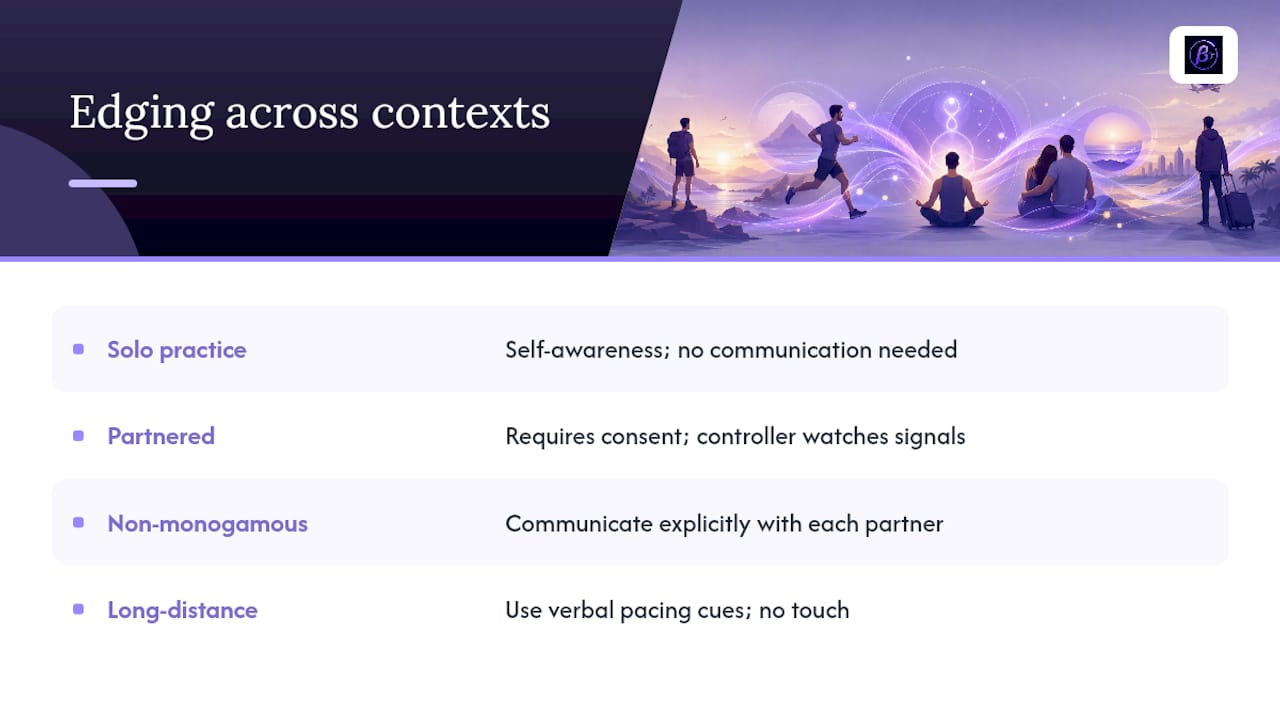
The mechanics of edging do not change based on orientation or relationship structure, but the practical application does.
For solo practice, edging is straightforward: it is entirely about self-awareness, with no communication layer required. This is often the best starting point regardless of relationship status, since it lets you learn your own signals without added pressure.
In partnered relationships, regardless of the genders involved, the key addition is a consent framework. Whoever is not controlling the pace needs a clear way to signal comfort, and whoever is controlling it needs to actually watch for those signals rather than assuming. This applies identically in same-sex and different-sex relationships. The technique itself is not oriented toward any particular anatomy; the pause-and-resume principle works the same way for any body.
Non-monogamous or multi-partner situations add one more layer: communication needs to be explicit with each partner individually, since comfort with edging as a practice can vary person to person even within the same relationship structure.
Long-distance or solo-with-partner-input arrangements, common with video calls or apps, can still incorporate edging through verbal pacing cues even without physical presence.
The through-line across all of these is the same: edging is a skill practiced by an individual body, and its relational value depends entirely on how well that individual communicates their arousal state to whoever else is involved.
An Editorial Take on Structured, Evidence-Aligned Practice
The research on edging supports a modest, specific claim: it can improve ejaculatory control and make orgasms feel more intense, largely through learned recognition of the point of inevitability. It does not support the broader idea, common in casual online discussion, that longer is always better or that edging alone fixes deeper confidence issues.
Where conventional advice falls short is treating edging as a standalone trick rather than a skill that depends on a supporting foundation, particularly pelvic floor strength and the ability to stay present instead of anxious. Someone who tries stop-start a handful of times without ever training the underlying muscles or addressing the mental noise around performance will likely see inconsistent results and assume the technique does not work.
Readers should prioritize consistency over intensity. A few minutes of focused practice most days, paired with basic pelvic floor training, builds the skill far more reliably than occasional long sessions pushed to the edge of discomfort. Edging is a technique. Whether it delivers depends on the foundation underneath it.
— ProjectBetter
This article is general information, not a substitute for advice from a qualified doctor. Consult a qualified healthcare professional about your own circumstances before acting on anything here.
Sources
- International Society for Sexual Medicine — What is edging and why might it be employed?
- Medical News Today — Is edging bad for you?
- Healthline — Edging & orgasm control
- PMC article — epididymal hypertension / pelvic vasocongestion explanation
- PMC article — pelvic floor and sexual function
FAQ
Does Edging Increase Testosterone Levels?
There is no solid clinical evidence that edging raises testosterone levels. The benefits it does support, better control and stronger eventual orgasms, come from arousal mechanics and pelvic floor engagement, not hormonal changes.
Is Edging for Very Long Periods Healthy?
Sessions that long are not necessary and can increase the risk of discomfort like epididymal hypertension, commonly known as blue balls. Shorter, focused sessions of a few repetitions tend to build control just as effectively with less physical strain.
What Happens if You Edge Every Day?
Daily practice in short sessions is generally safe and may build control skills faster through repetition, but signs of irritation, fatigue, or frustration mean it is time to reduce frequency rather than push through.
Is Edging Actually Worth Trying?
For most people wanting better stamina, stronger orgasms, or more control over ejaculation, yes. The techniques are low-risk, well documented in clinical literature, and require no special equipment to start.
Can Edging Help With Premature Ejaculation Specifically?
Yes. Stop-start and squeeze techniques were originally developed as clinical treatments for premature ejaculation, and they remain a recommended first approach before other interventions.