Guided Pelvic Floor Exercises for Men: 30-Day Plan
Most men notice some improvement after 4–6 weeks of consistent pelvic floor training, with more significant changes typically taking up to 3 months. That’s the core claim, and it’s backed by Mayo Clinic guidance on Kegel training for men. You don’t need equipment, a gym, or a long block of time.
Your start-now plan:
- Lie down on your back, knees bent. Contract your pelvic floor for 3 seconds, relax for 3 seconds. Do 10 reps.
- Repeat that set twice more during the day, once seated and once standing.
- Expect early signs of improvement at 4–6 weeks, with more significant change by 3 months.
That’s one complete day of guided pelvic floor exercises for men. The 30-day program below builds from there, week by week, with clear progressions and practical habit cues.
Table of Contents
- What does the pelvic floor do for men’s sexual health?
- How to follow a progressive 30-day pelvic floor routine
- What mistakes do men most often make?
- When should you see a professional instead of training alone?
- How to make pelvic floor training stick every day
- Key Takeaways
- Why guidance changes everything about this kind of training
- Projectbetter gives you a private, structured path forward
- FAQ
What does the pelvic floor do for men’s sexual health?
The pelvic floor is a group of muscles and connective tissue that forms the base of your pelvis. For men, the key muscles are the levator ani group (which includes the pubococcygeus and iliococcygeus), the bulbocavernosus, and the ischiocavernosus. Together, they support your bladder, bowel, and prostate, and they play a direct role in sexual function.
Cleveland Clinic notes that these muscles help regulate penile blood flow and ejaculatory control. When they’re strong and well-coordinated, they contribute to firmer erections and better control during sex. When they’re weak or overactive, the result can be urinary leakage, reduced sensation, or difficulty with ejaculatory timing.
Oxford Health guidance confirms that pelvic floor training is appropriate across age groups, including middle-aged and older men dealing with incontinence or pelvic weakness. The muscles also work with your core and diaphragm to manage intra-abdominal pressure during lifting, coughing, and exercise.
Key functions at a glance:
- Supports the urethra and helps prevent stress urinary leakage
- Contributes to erectile rigidity by compressing veins that drain blood from the penis
- Controls ejaculatory timing through coordinated muscle contractions
- Works with the diaphragm to stabilize the core and spine
Pro Tip: Before your first set, take three slow diaphragmatic breaths. Inhale through your nose, letting your belly rise, then exhale gently. Your pelvic floor should soften on the inhale and lift slightly on the exhale. This breath-muscle coordination is the foundation of correct technique.
How to follow a progressive 30-day pelvic floor routine
Finding the right muscles first
Before you begin, you need to locate the correct muscles. The safest method: try to stop your urine flow mid-stream, just once, to identify the sensation. Mayo Clinic is clear that this is a diagnostic check only, not a training method. Doing it regularly disrupts bladder rhythm.
A more reliable daily check: sit in front of a mirror and contract. If the base of your penis and scrotum lift slightly, you’ve found the right muscles. If you feel an outward push instead, you’re compensating with your abs or glutes. A rectal finger check can also confirm correct activation for men who have difficulty with the visual cue.

Week-by-week progression
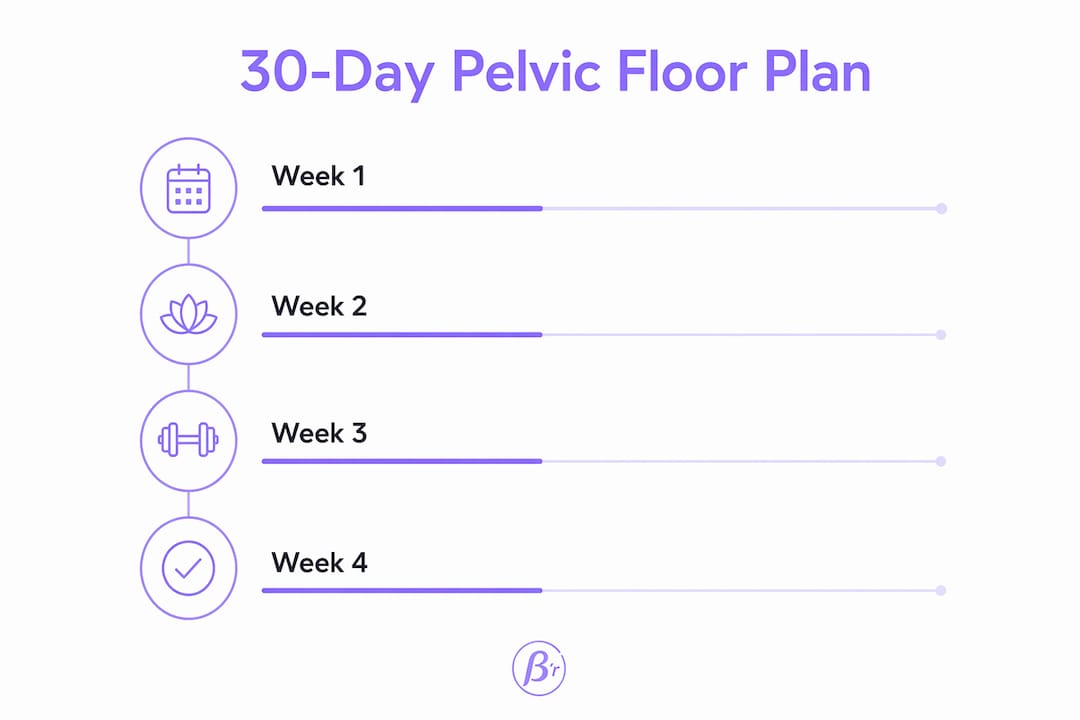
| Week | Position | Slow hold | Fast squeezes | Sets/day |
|---|---|---|---|---|
| 1 | Lying | 3 sec hold, 3 sec rest | 10 quick 2-sec squeezes | 1 |
| 2 | Lying + sitting | — | 10 quick squeezes | 2 |
| 3 | Sitting + standing | — | 10 quick squeezes | 2 |
| 4 | All three positions | 10 sec hold, 10 sec rest | 10 quick squeezes | 2–3 |
Beginners often fatigue after 3–6 reps in the first week. That’s normal and means you’re activating the right muscles. Build to multiple strong holds of gradually increasing duration as your strength develops.
Your daily session, step by step
- Warmup (1 minute): Three slow diaphragmatic breaths. Let your belly expand on each inhale; feel the pelvic floor soften.
- Slow holds: Contract the pelvic floor, hold for the target duration, then fully release. Breathe normally throughout. Never hold your breath.
- Quick squeezes: Contract hard and fast for 2 seconds, then fully relax. Ten reps per set.
- Relaxation work: After your last set, spend 30 seconds consciously releasing all tension in the pelvic floor, glutes, and inner thighs.
Modifications for specific conditions
Men with erectile dysfunction should start with lying-down sets only for the first two weeks, focusing on full relaxation between contractions. Men with urinary leakage benefit from adding a “squeeze before you sneeze” habit: contract firmly just before any moment of physical pressure. For men recovering from prostate surgery, Cleveland Clinic recommends beginning pelvic floor training before the procedure when possible, then resuming gently post-catheter removal under clinical guidance.
Biofeedback and digital tools are worth adding if you’re unsure about technique after two weeks. Biofeedback devices use sensors to display your contractions in real time, making it easier to confirm correct activation and track progress. Apps with guided audio sessions, like those in the Projectbetter program, serve a similar function by cueing timing and breathing without requiring clinic visits.
Habit-stacking cues to keep you consistent:
- After brushing your teeth each morning: one lying-down set
- After urinating: one seated set (bladder empty, muscles relaxed)
- During your commute or lunch break: one standing set
What mistakes do men most often make?
The most common error is doing too many reps too soon. MedlinePlus notes that excessive repetitions can actually increase leakage and cause muscle fatigue. The pelvic floor needs graded loading, not the volume-focused approach you’d use for biceps.
Frequent technique errors and their fixes:
- Recruiting glutes, abs, or thighs: If your stomach moves during a contraction, you’re using the wrong muscles. Place one hand on your belly; it should stay still.
- Holding your breath: This raises intra-abdominal pressure and fatigues the pelvic floor quickly. Count out loud during each hold if needed.
- Skipping the relaxation phase: A full release between contractions is as important as the contraction itself. Rushing through rests leads to a chronically tense pelvic floor.
- Using the stop-urine test as a daily drill: Use it once for identification, then stop. Regular use disrupts bladder function.
- Progressing too fast: Stay at each week’s level until the holds feel controlled and easy before moving forward.
Pro Tip: If you notice increased leakage, pelvic heaviness, or discomfort after a session, take a full rest day and reduce your rep count by half. These are signs of overwork, not weakness. Recovery is part of the program.
When should you see a professional instead of training alone?
Most men can begin a home-based pelvic floor program safely. But some situations call for professional input before or alongside self-directed training.
Seek a pelvic-floor physiotherapist or urologist if:
- Leakage or urgency worsens after 4–6 weeks of consistent practice
- You experience new pelvic pain, pressure, or discomfort during or after exercises
- You cannot locate or feel the pelvic floor muscles after two weeks of trying
- You’re preparing for or recovering from prostate surgery
- You notice signs of urinary retention (difficulty starting flow, incomplete emptying)
A pelvic-floor physiotherapist can perform an internal assessment to identify whether your muscles are weak, overactive, or uncoordinated, and tailor a plan accordingly. Biofeedback and electrical stimulation are valid clinical adjuncts when a man struggles to isolate the muscles on his own.
Timeline to keep in mind: most men notice some improvement at 4–6 weeks. Major changes in continence and sexual function typically take up to 3 months of daily practice. If you’ve trained consistently for 12 weeks with no change, that’s the clearest signal to book a clinical appointment.
How to make pelvic floor training stick every day
Consistency matters more than perfection. Daily practice, even a few minutes, builds meaningful strength over time. The men who see results are usually the ones who attach their sets to something they already do, not the ones who try to carve out a separate workout.
Practical habit-stacking ideas:
- Morning: lying set while still in bed, before you get up
- Post-urination: seated set, muscles already relaxed
- Evening shower: standing set, warm water as a relaxation cue
- Phone alarm labeled “3-second lift” as a midday reminder
A sample daily schedule might look like this: 7 AM (lying, 10 slow holds), 1 PM (seated, 10 slow holds + 10 quick squeezes), 9 PM (standing, 10 slow holds). That’s roughly five minutes total. Community-sourced tips from men who’ve built this habit consistently point to one shared insight: keeping the sets short enough that skipping feels harder than doing them. For more adherence strategies drawn from real-user experience, the Reddit-sourced tips compiled by Projectbetter are worth a read.
Track your progress simply: note how many seconds you can hold comfortably at the start of each week. That single number, improving gradually, is enough feedback to stay motivated without obsessing over metrics.
Key Takeaways
A consistent daily Kegel routine, progressed over 30 days from lying to standing positions, is the most effective self-directed approach to male pelvic floor strength and sexual confidence.
| Point | Details |
|---|---|
| Start simple, start today | Three sessions daily (lying, seated, standing) is the full program structure from day one. |
| Expect results at 4–6 weeks | Most men notice some improvement after 4–6 weeks; major changes typically take up to 3 months. |
| Technique beats volume | Correct muscle isolation and full relaxation between reps matter more than high rep counts. |
| Know when to escalate | Worsening symptoms after 4–6 weeks or new pelvic pain are signals to consult a pelvic-floor physiotherapist. |
| Projectbetter structures the process | The 30-day Projectbetter program provides guided audio sessions, habit tracking, and progressive pelvic floor protocols for men focused on sexual wellbeing. |
Why guidance changes everything about this kind of training
Most men who try pelvic floor exercises on their own quit within two weeks. Not because the exercises are hard, but because there’s no feedback loop. You can’t see the muscle working. You don’t know if you’re doing it right. And without a clear progression, it’s easy to plateau or overtrain and assume the whole thing doesn’t work.
What actually drives results is structure: knowing exactly what to do today, how it connects to what you did yesterday, and what to expect next week. That’s what separates a guided program from a list of exercises. The behavioral side matters just as much as the physical. Men who track their practice, even informally, stay consistent longer. Men who pair their sets with a daily cue, like brushing their teeth or a morning breath routine, build the habit faster than those who rely on motivation alone.
Sexual confidence, specifically, tends to emerge as a secondary gain once functional control improves. When you can feel the muscle working, when leakage becomes less frequent, when you notice more awareness during intimacy, that’s when the psychological shift happens. It’s not dramatic. It’s quiet and cumulative. And it’s exactly the kind of progress that a structured, private program is designed to support.
Projectbetter gives you a private, structured path forward
If you want the structure without figuring it out alone, Projectbetter’s 30-day program is built specifically for this. Every day includes a guided pelvic floor session with audio cues for timing and breathing, a short movement protocol, and a self-reflection prompt. Progress tracking and habit logging are built in, so you always know where you are in the program.

The program runs on iOS with flexible subscription options, including a free trial, so you can experience the guided format before committing. It’s private, calm, and designed for men who want real progress without performance pressure. If you’re ready to move from knowing what to do to actually doing it consistently, start the 30-day program at Projectbetter.
FAQ
How often should men do pelvic floor exercises?
Three sessions per day is the standard recommendation, with each session taking just a few minutes. Consistency over weeks matters more than any single session’s volume.
How long before guided pelvic exercises improve sexual function?
Most men notice early improvements in control and awareness within several weeks; more significant changes can take a few months of daily practice.
Can men with erectile dysfunction benefit from pelvic floor training?
Yes. Cleveland Clinic notes that pelvic floor muscles help regulate penile blood flow, making targeted training a relevant, non-invasive support for erectile function.
What’s the best position to start pelvic floor exercises?
Lying down with knees bent is the easiest starting position because gravity assists muscle awareness. Progress to seated and then standing sets as control improves.
When should a man see a pelvic-floor physiotherapist?
If symptoms worsen after several weeks, you can’t locate the muscles, or you’re recovering from prostate surgery, a physiotherapist can provide an internal assessment and a tailored plan.