What Sexual Performance Anxiety Sex Worries Really Mean
Sexual performance anxiety is a stress response, not a diagnosis: fear about how you’ll perform during sex triggers a spike in stress hormones that narrows blood flow and pulls your attention away from pleasure and into self-monitoring. That shift from feeling to watching is often the entire problem. The single most useful first step tonight is simple: stop trying to “perform” and shift the goal to sensation. Slow your breathing, tell your partner (or yourself) that intercourse is off the table for now, and let touch happen without a finish line.
That one change, removing the pressure to “succeed,” interrupts the anxiety loop faster than almost anything else you can try in the moment.
Three things to do right now if you feel the anxiety creeping in:
- Breathe slowly through your nose for a count of four, hold for four, exhale for six. This calms the sympathetic nervous system that anxiety hijacks.
- Say out loud (or think clearly) that nothing needs to happen tonight beyond touch and closeness.
- Redirect attention to a physical sensation, skin, warmth, breath, instead of monitoring your own response.
If this pattern repeats across weeks or months, or if you notice erection or arousal problems even when you’re not anxious, it’s worth a conversation with a doctor to rule out physical causes.
Pro Tip: The fastest way to lower performance pressure isn’t trying harder. It’s removing the test entirely. When there’s nothing to fail, there’s often nothing to fear.
Key Takeaways
Performance anxiety during sex is a treatable stress response, and shifting focus from performance to sensation is the most reliable first step toward lasting change.
| Point | Details |
|---|---|
| Anxiety, not diagnosis | Sexual performance anxiety is a stress response that disrupts arousal, not a formal medical condition. |
| Check solo vs. partnered function | Erections during masturbation or in the morning point toward anxiety rather than a physical cause. |
| Sensate focus works | Non-genital touch first, then genital touch, is the clinically backed way to break the self-monitoring cycle. |
| Persistent symptoms need evaluation | See a doctor if issues last more than a few months or if red-flag symptoms like pain or sudden onset appear. |
| Structured practice beats willpower | Project β’r offers a private 30-day program combining pelvic floor training, meditation, and habit tracking to support this process. |
Table of Contents
- What Causes Performance Anxiety During Sex?
- How Performance Anxiety Shows Up and Affects Your Sex Life
- Performance Anxiety or Erectile Dysfunction: How to Tell the Difference
- What to Try Tonight and Over the Next Few Weeks
- Long-Term Treatments That Actually Work
- When to See a Doctor and How to Prepare
- A 30-Day Plan to Rebuild Confidence and Reduce Pressure
- Common Myths About Sexual Performance Anxiety
- How Past Sexual Trauma Shapes Present-Day Anxiety
- Why Compassion Works Better Than Willpower
- A Private Way to Work Through Performance Pressure
- Sources
- FAQ
What Causes Performance Anxiety During Sex?
Performance anxiety rarely comes from one source. It’s usually a mix of psychological, relational, situational, and sometimes physical factors, and figuring out which combination applies to you determines what actually helps.
Psychological contributors tend to center on what clinicians call a “performance mindset,” treating sex like a test with a pass or fail outcome. This often shows up as spectatoring, mentally stepping outside the moment to monitor your own arousal or your partner’s reaction instead of being present in it. Psychology Today notes that the belief sex must “prove” something, virility, attractiveness, adequacy, is one of the most common roots of this anxiety, and shifting the goal from proving to sharing pleasure tends to ease it.
Relational contributors show up as communication gaps and unspoken scripts about what sex is “supposed” to look like. A past awkward encounter, an offhand comment from a partner, or an unresolved conflict can quietly become an “intimacy injury” that resurfaces every time things get physical.
Situational contributors are often the easiest to spot: new partners, a first time together, exhaustion, alcohol, or general life stress can all lower your capacity to relax into sex, even when nothing is medically wrong.
Physical contributors need to be considered too, particularly when anxiety doesn’t fully explain the pattern. Diabetes, low testosterone, cardiovascular disease, and medications like SSRIs are all known to affect arousal and function. Cleveland Clinic’s overview of sexual dysfunction points out that these dysfunctions are common and frequently involve overlapping psychological and physical causes, which is exactly why a combined assessment often works better than guessing.
A man in his 30s might have zero physical issues but still struggle with a new partner because his internal script says “this has to go perfectly.” A man in his 50s with the same anxious thoughts might also have declining testosterone contributing to the picture. Same symptom, different mix of causes, different starting point for treatment.
How Performance Anxiety Shows Up and Affects Your Sex Life
The physical symptoms are what most people notice first: difficulty getting or keeping an erection, a drop in arousal partway through, reduced lubrication, trouble reaching orgasm, or ejaculating sooner than intended. NHS guidance on ejaculation problems links many of these patterns directly to psychological stress rather than an underlying physical condition.
The mental symptoms are quieter but just as disruptive. Intrusive “what if” thoughts (What if I can’t get hard? What if she’s disappointed?) hijack attention mid-encounter. Negative self-talk after a disappointing experience compounds the fear for next time. Left unaddressed, this often leads to avoidance, finding reasons to skip intimacy altogether rather than risk another anxious episode.
The relational cost tends to build slowly. One partner reads the avoidance as rejection, the other reads the frustration as pressure, and a blame cycle forms where neither person is actually talking about what’s happening.
A few patterns show up repeatedly:
- A man performs fine solo but struggles with a partner, pointing toward anxiety rather than a physical limitation.
- A couple stops initiating sex altogether after a string of anxious encounters, even though neither wants that outcome.
- A partner interprets erectile difficulty as lost attraction, when it’s actually unrelated stress showing up in the bedroom.
Performance Anxiety or Erectile Dysfunction: How to Tell the Difference
This is the question most readers actually want answered, and there are real clues that separate the two, even though they can overlap.
If you get firm erections during masturbation or wake up with morning erections but struggle with a partner, that pattern points toward anxiety rather than a physical problem. Situational variability, fine in one context, not another, is one of the clearest signals that your body works but your mind is interfering. Gradual onset, consistent failure across every context including solo arousal, and a known medical condition (diabetes, heart disease, low testosterone) point more toward an organic cause.
| Signal | Points toward performance anxiety | Points toward physical cause |
|---|---|---|
| Morning or solo erections | Present and reliable | Often absent or weak |
| Onset pattern | Sudden, tied to a specific event or partner | Gradual, worsening over months |
| Consistency | Varies by situation or partner | Consistent across all situations |
| Related health issues | None known | Diabetes, cardiovascular disease, low testosterone |
| Medication timeline | No new medications | Started around the same time as symptoms |
Some symptoms warrant prompt medical attention regardless of anxiety: sudden and complete loss of function, pain during erection or ejaculation, blood in semen, or other signs of systemic illness like unexplained fatigue or weight change.
If symptoms persist longer than a few months or the picture is unclear, PMC’s guidance on differentiating organic and psychogenic dysfunction recommends clinical evaluation rather than continuing to guess. A general practitioner can start with bloodwork checking testosterone, blood sugar, and cardiovascular markers, and refer you to a urologist or endocrinologist if something specific turns up.
What to Try Tonight and Over the Next Few Weeks
Short-term relief and longer-term change require different tools, and it helps to know which one you’re reaching for.
In the moment, three techniques do most of the work:
- Paced breathing, slow inhale, longer exhale, calms the physiological anxiety response before it escalates.
- A “ground-sense anchor,” focusing on one specific physical sensation (the warmth of skin, the rhythm of breath) pulls attention out of your head and back into your body.
- A permission statement, telling yourself or your partner that nothing has to happen beyond touch, removes the pass/fail frame entirely.
Over days and weeks, sensate focus is the technique most consistently recommended by clinicians. It works in stages: non-genital touch first, purely about sensation with no goal of arousal, followed by genital touch once the anxiety around non-genital touch has eased, and only later a gradual return to intercourse. Clinical research on sensate focus describes this progression as one of the most effective ways to disrupt the self-monitoring loop that drives performance anxiety. Combine it with masturbation practice that focuses purely on sensation rather than speed or outcome, and gradual, low-stakes exposure to sexual situations without pressure to finish.
A simple checklist for early sensate focus sessions:
- Set a time limit and stick to it, no chasing arousal past the window.
- Agree in advance that intercourse is off the table.
- Check in verbally during the exercise (“that feels good,” “slower here”).
- End the session regardless of arousal level. That’s the point.
Communication scripts matter more than most people expect. A short, de-escalating line like “I want to slow down and just enjoy this without a goal” does more to reduce shared anxiety than an explanation of what’s wrong.
Pro Tip: Most early setbacks happen because people skip the non-genital stage of sensate focus, jumping straight back to intercourse the moment they feel less anxious. Give the earlier stages real time before moving on.
Long-Term Treatments That Actually Work
Behavioral and talk therapies remain the backbone of treatment, and they tend to work best combined rather than used alone.
Cognitive behavioral therapy (CBT) targets the thought patterns behind performance anxiety directly, the catastrophizing, the mental rehearsal of failure, the all-or-nothing thinking about what counts as “good” sex. A review of performance anxiety models frames the anxiety as a shift from reflexive, automatic sexual responding to overly conscious, reflective monitoring, and CBT is one of the main tools for reversing that shift. Expect a course of several weeks to a few months, depending on how entrenched the thought patterns are.
Sex therapy and couples therapy address the relational layer, communication breakdowns, mismatched expectations, and unspoken resentment that individual therapy alone won’t touch.
Pelvic floor training is an underused but well-supported piece of the puzzle. Strengthening and gaining conscious control over the pelvic floor muscles can improve erectile rigidity and ejaculatory control, giving men a physical sense of agency that complements the psychological work. Structured routines, like the pelvic floor training programs built around daily repeatable exercises, pair naturally with sensate focus practice.
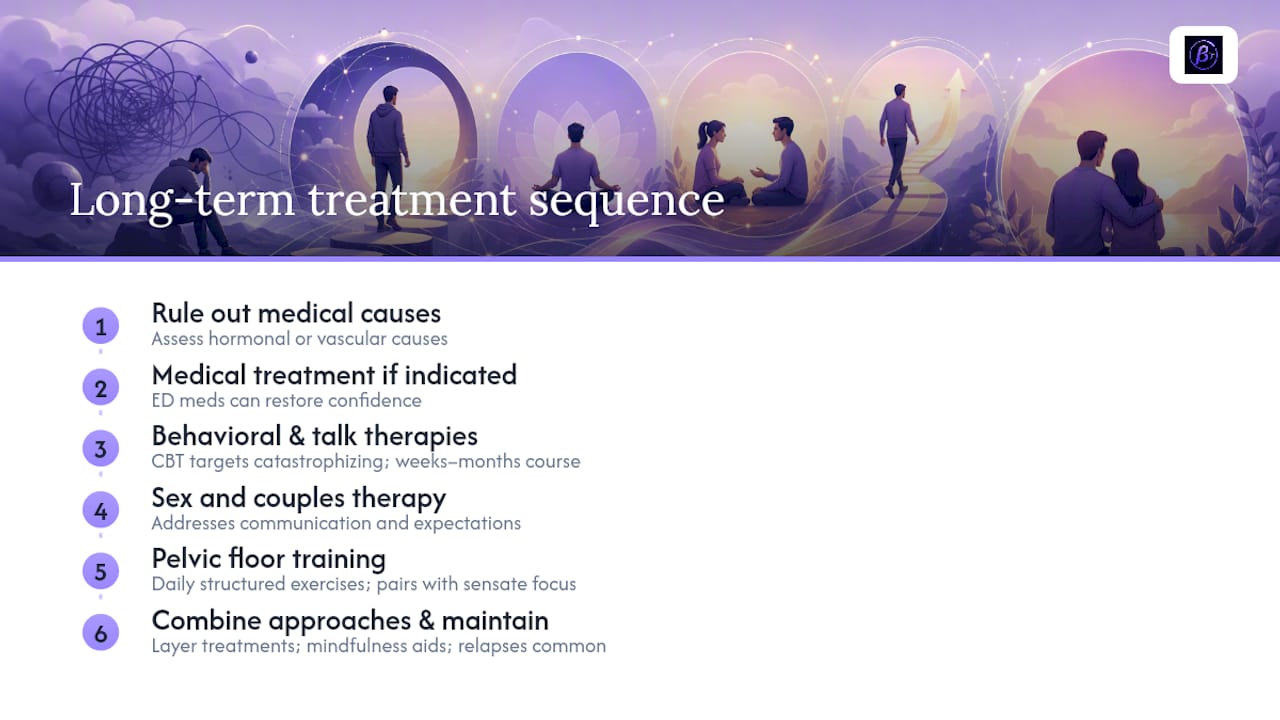
Mindfulness training supports all of the above by reducing the general baseline of anxious self-monitoring, not just during sex but in daily life.
Medical options have a role too, particularly when a physical contributor is confirmed. Erectile dysfunction medications can help some men break the anxiety cycle by restoring confidence in the body’s response, and addressing hormonal or vascular issues directly resolves the physical piece where it exists. Be cautious with over-the-counter supplements marketed for performance. Many carry unverified ingredients, and relying on them instead of a proper evaluation can delay identifying a treatable medical cause.
Combined approaches, ruling out medical causes first, then layering in behavioral and psychological treatment, consistently produce better long-term outcomes than any single intervention used alone.
Relapse is common and not a sign of failure. Stress, a new partner, or a rough patch in a relationship can bring anxious patterns back temporarily. The skills built through sensate focus and CBT tend to make relapses shorter and less severe over time.
When to See a Doctor and How to Prepare
Getting professional help is often easier than people expect, and knowing who to call removes a real barrier.
Start with a general practitioner if you’re unsure where the problem sits. They can run baseline bloodwork, review medications, and refer you onward. A urologist specializes in erectile and ejaculatory function specifically. An endocrinologist is the right call if hormone levels (testosterone, thyroid) are suspected. A certified sex therapist is the specialist for anxiety and relational patterns that don’t have an obvious physical driver.
Clinicians typically ask about your medical history, current medications, sexual history including when the problem started and whether it’s situational, and they may order blood work checking testosterone and glucose levels. NHS guidance on erection problems confirms this stepwise approach, ruling out common medical contributors before or alongside addressing psychological ones.
A short checklist before your appointment:
- Write down when symptoms started and whether they’re consistent or situational.
- List all current medications and supplements, including anything over-the-counter.
- Note whether solo arousal (masturbation, morning erections) differs from partnered sex.
- Prepare two or three questions you want answered, even if they feel awkward to ask.
Pro Tip: You don’t need your partner in the room for this conversation, but if the anxiety is relational, a joint appointment or a couples-focused session later can move things faster.
Seek evaluation sooner rather than later if you notice sudden and complete loss of function, pain, or other signs of a broader health issue. These warrant prompt attention regardless of how anxious you’ve been feeling.
A 30-Day Plan to Rebuild Confidence and Reduce Pressure
A structured, time-limited plan gives you something concrete to follow instead of vague intentions to “relax more.”
Week 1 focuses on reducing immediacy and building understanding. Read about how performance anxiety works, practice paced breathing daily, and have one low-pressure conversation with your partner about slowing down, no problem-solving required yet.
Week 2 introduces sensory practice and pelvic floor work. Begin non-genital sensate focus sessions two to three times, and start a basic pelvic floor exercise routine, five to ten minutes a day.
Week 3 shifts to partner communication and graded exposure. Progress sensate focus into genital touch without a goal of intercourse, and practice one direct conversation about what’s working and what still feels rushed.
Week 4 is about consolidation. Reintroduce intercourse gradually, without pressure to “finish” every time, and build a simple relapse plan: what you’ll do the next time anxiety spikes.
- Days 1 to 7: education, breathing practice, one honest conversation.
- Days 8 to 14: non-genital touch sessions, daily pelvic floor reps.
- Days 15 to 21: genital touch stage, one check-in conversation per week.
- Days 22 to 30: gradual return to intercourse, relapse plan written down.
Track progress with simple prompts: rate anxiety before and after each session on a scale of one to ten, note whether you stayed present or slipped into self-monitoring, and write one sentence after each week about what changed.
This plan isn’t appropriate for everyone without modification. If you have a history of sexual trauma, a diagnosed anxiety or mood disorder, or any of the red-flag physical symptoms mentioned earlier, loop in a therapist or physician before starting rather than working through it alone. Research on nervous system regulation confirms that lowering sympathetic arousal, not forcing yourself through discomfort, is the actual mechanism behind lasting change.
Common Myths About Sexual Performance Anxiety
The idea that “real men” don’t get anxious about sex is one of the most damaging myths out there, and it’s simply false. Performance anxiety affects men across every age group and relationship status, and it has nothing to do with masculinity or attraction to your partner.
Another common misconception: that performance anxiety means something is fundamentally wrong with you. It’s a stress response, a predictable reaction to pressure and self-monitoring, not a character flaw or a sign of diminished desire.
Many people also assume that trying harder or “just relaxing” will fix it. Willpower rarely works here, and pushing through discomfort tends to reinforce the anxiety loop rather than break it. The mechanism that actually works is de-escalating the nervous system through breathing, sensate focus, and gradual exposure, not gritting your teeth and hoping for the best.
Finally, there’s a persistent myth that performance anxiety only affects erections. It shows up just as often in reduced arousal, delayed or absent orgasm, and premature ejaculation, and it affects people with any anatomy, not exclusively men with erectile concerns.
How Past Sexual Trauma Shapes Present-Day Anxiety
A negative or traumatic sexual experience, whether it happened once or repeatedly, can leave a lasting imprint that shows up as performance anxiety years later, even in a safe, trusting relationship.
This isn’t always dramatic or obvious. Sometimes it’s a single humiliating comment during an early sexual experience that quietly became a rule: “I have to be perfect or I’ll be mocked.” Sometimes it’s a more serious trauma that requires dedicated trauma-informed therapy before behavioral techniques like sensate focus can even begin to help.
The key distinction is this: performance anxiety rooted in general nervousness usually responds well to the behavioral steps outlined above. Performance anxiety rooted in trauma often needs a therapist trained specifically in trauma work first, because the body’s stress response may be protecting against something deeper than a fear of “failing” in the moment. If sensate focus or breathing exercises trigger disproportionate distress, flashbacks, panic, or dissociation, that’s a signal to bring in a trauma-informed therapist rather than continuing self-guided practice.
Why Compassion Works Better Than Willpower
Performance anxiety is one of the most common and most treatable issues in men’s sexual health, and the biggest barrier to fixing it usually isn’t the anxiety itself. It’s shame keeping people from talking about it.
What gets underestimated is how much self-criticism actively worsens the problem. Trying to force your way through an anxious episode with willpower or frustration tends to deepen the very self-monitoring that causes the anxiety in the first place. The men who make the fastest progress are the ones who treat the process with the same patience they’d apply to any other skill: showing up consistently, expecting some setbacks, and staying curious instead of harsh with themselves when things don’t go perfectly.
Structured, private practice tends to outperform vague intentions to “try to relax.” A clear framework removes the guesswork and gives you something concrete to return to, which matters more than motivation on any given night.
A Private Way to Work Through Performance Pressure
Reading about sensate focus and pelvic floor training is one thing. Practicing it consistently, privately, without having to explain yourself to anyone, is another. Project β’r is a 30-day, app-based program built specifically for men working through performance pressure, low sexual confidence, and habits that get in the way of intimacy.
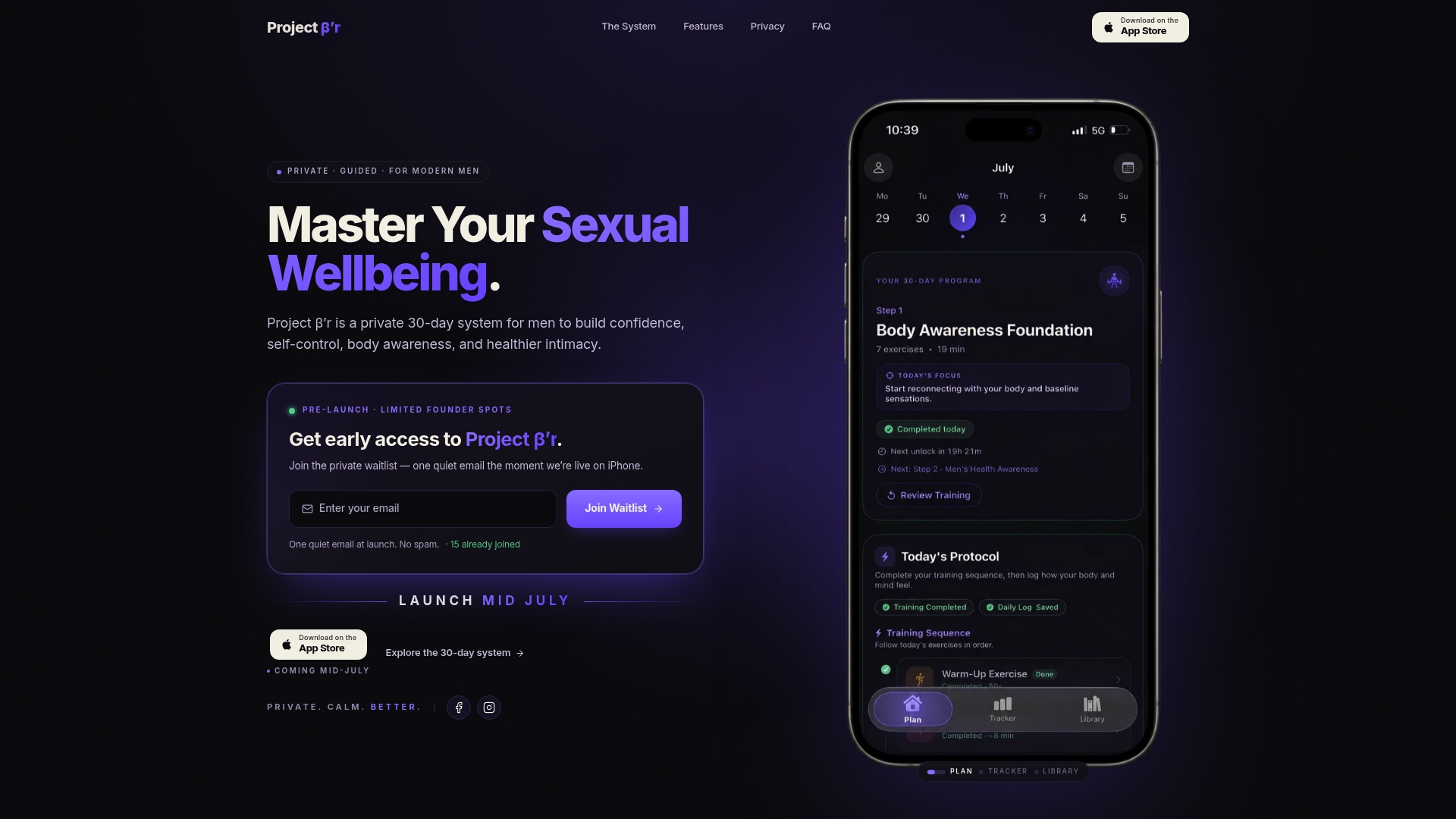
The program is structured around daily protocols rather than open-ended advice: guided pelvic floor training, movement exercises, guided audio meditations for calming the nervous system before intimacy, daily reflection prompts, and private mood and habit tracking so you can see what’s actually changing week to week. Everything happens on your own phone, on your own schedule, with no judgment and no one else involved unless you choose to bring a partner in.
If the practical steps in this article resonated, the program turns them into a guided, day-by-day sequence instead of something you have to piece together alone. You can start with the free trial through the Project β’r app and see whether the structure fits before committing further. If you’re experiencing any of the red-flag symptoms mentioned earlier, sudden onset, pain, or signs of an underlying medical condition, see a doctor first; the program is designed to support psychological and behavioral change, not replace medical evaluation.
Sources
These sources go deeper into the medical and clinical detail behind the guidance in this article, and none of them replace an actual exam with your own doctor.
- Sexual Dysfunction: Disorders, Causes, Types & Treatment — Cleveland Clinic
This article is general information, not a substitute for advice from a qualified doctor. Consult a qualified healthcare professional about your own circumstances before acting on anything here.
FAQ
How Can I Overcome Sex Performance Anxiety?
Start by removing the goal of “performing,” shift your focus to touch and sensation instead of intercourse, practice paced breathing, and use sensate focus exercises over several weeks. If anxiety persists, CBT and sex therapy are the most evidence-backed next steps, and a structured program like Project β’r can provide the daily framework to practice consistently.
What Is the 3-3-3 Rule for Anxiety?
The 3-3-3 rule is a general grounding technique, name three things you see, three sounds you hear, and move three parts of your body, used to interrupt acute anxiety in the moment. It isn’t a sex-specific clinical protocol, but the grounding principle behind it overlaps with the ground-sense anchoring described earlier in this article.
How to Help a Husband With Performance Anxiety?
Remove pressure rather than adding reassurance about performance specifically. Say plainly that intercourse isn’t the goal tonight, focus on touch without expectation, and consider bringing up sensate focus together or suggesting a conversation with a doctor if the pattern continues for more than a few weeks.
How to Tell if It’s Performance Anxiety or ED?
If erections happen reliably during masturbation or upon waking but not with a partner, anxiety is the likely cause. Gradual onset, consistent failure across every situation, and known conditions like diabetes or cardiovascular disease point more toward a physical cause worth evaluating with a doctor.