Pelvic Floor App Reviews: Best Picks for 2026
TL;DR:
- The best pelvic floor apps in 2026 include Squeezy, Pelvic Floor First, and others, each catering to different needs. Clinical and privacy features vary, with paid apps generally offering better privacy protections and technical support than free ones. Selecting the right app depends on your condition, goals, and whether professional guidance is involved.
What are the best pelvic floor exercise apps right now?
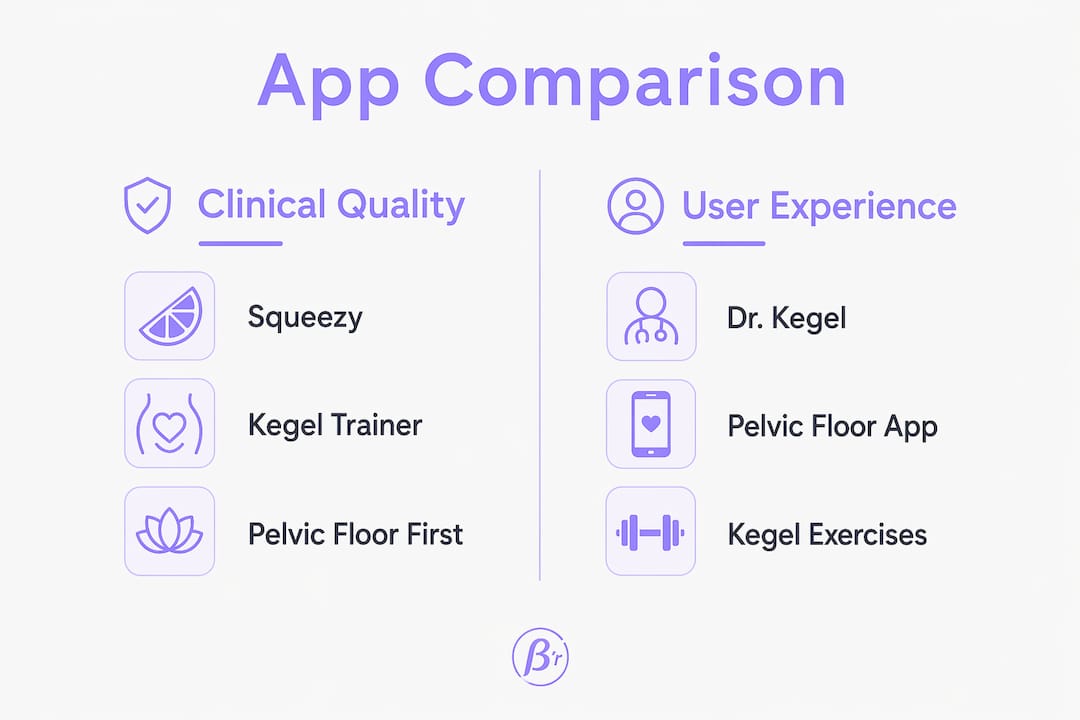
The strongest pelvic floor apps available in 2026 are Squeezy, Kegel Trainer – Exercises, Pelvic Floor First, Dr. Kegel, Kegel Exercises Pelvic Floor, and Pelvic Floor App. Each addresses a different need, from NHS-endorsed clinical programs to beginner-friendly reminders and condition-specific guidance. If you want one clear starting point: Squeezy leads on clinical credibility, while Pelvic Floor First offers the most complete free experience.
A 2018 PubMed study evaluated 90 pelvic floor apps and found that paid apps averaged a quality score of 9.93 versus 9.41 for free apps, with paid apps offering privacy features at a rate of 80% compared to 53% for free versions. That gap matters more than the small overall score difference. Choosing an app without privacy protections means your pelvic health data may be stored or shared in ways you haven’t agreed to.
Here is how the six leading apps compare across the dimensions that matter most.
| App | Best For | Clinical Effectiveness | User Rating | Free vs. Paid | Privacy Features | Platform | Tech Support |
|---|---|---|---|---|---|---|---|
| Squeezy | Clinical users, PT integration | High (NHS-endorsed, ORCHA Level 3) | — | Paid ($3.99) | Strong | iOS, Android | Yes |
| Kegel Trainer – Exercises | Expert-designed progress tracking | High (physiotherapist-designed) | — | Free + paid upgrade | Moderate | iOS, Android | Limited |
| Pelvic Floor First | Education + full-body training | Moderate-High | — | Free | Moderate | iOS, Android | Limited |
| Dr. Kegel | Flexible session lengths | Moderate | — | Free + paid | Moderate | iOS, Android | Limited |
| Kegel Exercises Pelvic Floor | Beginners, guided routines | Moderate | — | Free + paid | Moderate | iOS, Android | Limited |
| Pelvic Floor App | Multiple pelvic conditions | Moderate | — | Paid | Moderate | iOS, Android | Yes |
Key features at a glance:
- Squeezy: Customizable exercise plans, professional mode for clinician-tailored programs, bladder diary, visual and audio cues, progress tracking.
- Kegel Trainer – Exercises: Physiotherapist-designed routines, sessions ranging from 30 seconds to 3 minutes, progress tracking, free base with paid upgrade.
- Pelvic Floor First: Full-body core and pelvic workouts, anatomy visuals, beginner-to-advanced levels, shareable progress, completely free.
- Dr. Kegel: Varied timer options, visual cues, flexible session durations, reminder tools.
- Kegel Exercises Pelvic Floor: Simple incremental difficulty levels, daily reminders, clean interface.
- Pelvic Floor App: Condition-specific exercise adaptations, guided programs for diverse pelvic health issues.
How do these apps compare on clinical quality and user experience?
Pelvic floor app reviews across Reddit threads and major app stores consistently surface the same dividing line: apps that feel like a timer versus apps that feel like a program. The difference shows up in clinical design, privacy architecture, and whether the app can actually communicate with your physical therapist.
Clinical effectiveness
Squeezy holds the clearest clinical standing. It carries an ORCHA Level 3 condition management rating, was developed by physiotherapists specializing in women’s health, and is recommended by the NHS. Its professional mode lets a clinician log in and build a personalized exercise plan directly inside the app, which no other app on this list replicates. Pelvic floor muscle dysfunction affects over 600 million people globally, and Squeezy’s design reflects that scale of need.
Kegel Trainer – Exercises was the highest-rated free app in the PubMed evaluation mentioned above, scoring 9.41 in that study’s framework. Its routines are physiotherapist-designed, sessions are short enough to fit a lunch break, and the free tier covers two full levels before a paid upgrade is needed. The National Association for Continence reviewed it as the most basic of the three apps it tested, but noted it works well for anyone who simply wants daily kegel reminders with a clean structure.
Pelvic Floor First, developed by the Continence Foundation of Australia, goes further than kegel counting. It incorporates core strength work, anatomy visuals, and video-guided moves across beginner-to-advanced levels. Workouts run 30–50 minutes in full, though you can save individual exercises and build your own shorter routine. It also includes a share feature for working with a physical therapist, which is a meaningful clinical bridge for a free app.
User experience and interface design
Dr. Kegel and Kegel Exercises Pelvic Floor both prioritize simplicity. Dr. Kegel’s varied timer options and visual cues make it easy to customize session length without navigating complex menus. Kegel Exercises Pelvic Floor uses incremental difficulty levels that gradually build intensity, which works well for people who are new to structured pelvic training and want gentle progression without decision fatigue.

Pelvic Floor App addresses a wider range of conditions than most competitors. Where other apps assume a single user profile, this one adapts exercise plans to specific pelvic health issues, making it a practical choice for people managing prolapse, urgency incontinence, or post-surgical recovery alongside general strengthening.
Privacy and data security
The PubMed study found that paid apps offered privacy features at 80% versus 53% for free apps, and tech support at 73% versus 53%. Squeezy and Pelvic Floor App, both paid options, reflect that pattern. Apps that store data locally rather than in the cloud offer stronger privacy protection, but they carry a real trade-off: if you switch devices without a backup, your entire tracking history disappears. That is a practical concern worth weighing before you commit to any app that does not offer account-based syncing.
Pricing and subscription models
Squeezy costs $3.99 as a one-time purchase. Kegel Trainer – Exercises is free to download with a paid upgrade of up to $5.49 for access beyond level two. Pelvic Floor First is entirely free. Dr. Kegel and Kegel Exercises Pelvic Floor both offer free tiers with optional paid upgrades. Pelvic Floor App is a paid product, though its exact current pricing is not publicly listed in a single place and may vary by platform.
Technical support
Paid apps consistently offer better support access. Squeezy and Pelvic Floor App both provide technical support channels, which matters when you are using an app as part of an ongoing therapy program and encounter a sync issue or need to recover data. Free apps in this category typically rely on app store reviews as their de facto support forum.
How do you choose the right pelvic floor app for your needs?
Choosing well comes down to matching the app’s design to your actual situation, not just picking the highest-rated option. Here are the factors that genuinely separate a good fit from a frustrating one.
Factors to evaluate before downloading:
- Clinical personalization: Does the app let you adjust exercise type, duration, and intensity based on your specific condition? Apps that offer only one-size-fits-all kegel timers will plateau quickly for anyone with a diagnosed pelvic floor issue.
- Evidence-based protocols: Look for apps developed or reviewed by physiotherapists or endorsed by a recognized health body. Squeezy’s NHS endorsement and Kegel Trainer’s physiotherapist-designed routines are concrete signals of clinical grounding.
- Privacy by design: If you prefer that your health data stays on your device, choose an app with local storage. If you want to share progress with a clinician or switch devices freely, account-based syncing is worth the trade-off.
- Platform compatibility: Confirm the app runs on your current device and operating system version. Most of the apps listed here support both iOS and Android, but version requirements can vary.
- Cost structure: A one-time purchase like Squeezy’s $3.99 may suit you better than a subscription model if you plan to use the app long-term. Subscription tiers can add up, so check what the free version actually covers before upgrading.
- Motivational tools: Reminders, progress charts, and streak tracking all influence whether you stay consistent. Research on pelvic floor training shows that customization options significantly improve adherence by addressing diverse conditions and anatomies.
Suitability for different conditions and profiles:
If you are managing stress incontinence or working alongside a physical therapist, Squeezy’s professional mode is the clearest choice. For general pelvic strengthening with a focus on core integration, Pelvic Floor First covers more ground than any other free option. If you are a beginner who simply needs structure and reminders, Kegel Exercises Pelvic Floor or Dr. Kegel will get you started without overwhelming you.
People managing multiple or complex pelvic conditions should consider Pelvic Floor App for its condition-specific adaptations, or consult a pelvic floor physiotherapist before relying solely on any app. Apps with biofeedback hardware integration tend to produce stronger outcomes, but they require professional guidance rather than standalone use.
Pro Tip: If you are working with a physical therapist, ask them whether they support Squeezy’s professional mode before purchasing. A clinician-configured plan inside the app is meaningfully different from a generic preset, and it keeps your in-app progress aligned with your therapy sessions.
Data portability deserves more attention than most app reviews give it. If an app stores your exercise history locally and you upgrade your phone without a manual backup, that data is gone. For anyone tracking pelvic health over months or years, that continuity matters. Check whether the app offers an export function or cloud backup before you build a long-term habit around it.
What does the research say about pelvic floor app effectiveness?
The clinical evidence on pelvic floor apps is more nuanced than most top-rated pelvic app roundups suggest. Quality varies widely, and the highest-scoring apps in formal evaluations are not always the ones with the most downloads.
The PubMed evaluation of 90 pelvic floor apps found that overall quality scores were nearly identical between paid and free versions, with paid apps averaging 9.93 and free apps 9.41 on a standardized scoring system. The real differences appeared in specific features: paid apps were more likely to cite primary literature in their descriptions (33% versus 29%), use images and figures (53% versus 41%), and provide tech support (73% versus 53%). Those details matter for clinical use, even if they don’t show up in a star rating.
“The quality of the apps is markedly variable in both the paid and unpaid applications. Using the APPLICATIONS scoring system, the apps were very similar in overall quality and value.” — PubMed study, Evaluation of Smartphone Pelvic Floor Exercise Applications Using Standardized Scoring System
Squeezy’s ORCHA Level 3 rating places it in a category that most pelvic floor apps never reach. ORCHA evaluates digital health tools against clinical safety, data privacy, and usability standards, and Level 3 specifically designates condition management capability. That distinction separates Squeezy from apps that are essentially reminder tools with a kegel timer attached.
NHS clinicians advise prioritizing apps with clear clinical guidelines over those loaded with features that reduce engagement. Feature fatigue is a real pattern in pelvic health apps: people download an app with multiple modules, feel overwhelmed within the first week, and stop using it entirely. The apps with the best long-term adherence tend to be the ones that do fewer things with more clarity.
One area where most apps fall short is the integration of diaphragmatic breathing and core muscle work alongside kegel exercises. Apps focused purely on kegel counting miss the broader pelvic health picture, which includes relaxation, breathing coordination, and core engagement. Pelvic Floor First addresses this more directly than any other free app, which partly explains its strong user ratings despite offering no paid tier.
Users who want professional-grade documentation of their progress, rather than just a reminder to exercise, consistently report better outcomes. The difference between an app that logs your sessions and one that generates exportable progress reports for a clinician is the difference between a habit tracker and a therapeutic tool. Squeezy’s professional mode and Pelvic Floor First’s share feature both move in that direction, though neither fully replaces a formal therapy record.
For men specifically, pelvic floor training through apps is an underused resource. Structured pelvic floor exercises for men address incontinence, sexual function, and core stability, yet most mainstream apps are designed primarily with women in mind. That gap is worth naming when evaluating which app actually fits your anatomy and goals.
Key Takeaways
Squeezy leads on clinical credibility, Pelvic Floor First offers the strongest free experience, and paid apps consistently provide better privacy protections and tech support than free alternatives.
| Point | Details |
|---|---|
| Paid vs. free quality | Paid apps score slightly higher overall than free apps, but the real gap is in privacy protection and tech support availability, with paid apps offering these features at notably higher rates. |
| Clinical endorsement matters | Squeezy’s ORCHA Level 3 rating and NHS endorsement set it apart from apps that function primarily as reminder tools. |
| Privacy trade-offs | Local data storage protects privacy but risks losing your tracking history when you switch devices; account syncing solves that at a privacy cost. |
| Beyond kegel counting | Apps like Pelvic Floor First that integrate core work and breathing produce more complete pelvic health outcomes than single-exercise timers. |
| Projectbetter for men | Projectbetter’s 30-day structured program combines guided pelvic floor training with mood tracking and daily protocols built specifically for men’s pelvic and sexual wellbeing. |
The gap most pelvic floor apps still haven’t closed
Most pelvic floor app reviews focus on features and star ratings. What they rarely address is the deeper question: does the app actually change behavior over time, or does it just give you something to open for the first week?
The honest answer is that most apps in this category are reminder tools dressed up as programs. A timer that tells you to squeeze for five seconds, three times a day, is not a clinical program. It is a nudge. That is useful for some people, but it is not the same as a structured protocol that adapts to your condition, tracks your progress meaningfully, and connects your effort to a real outcome.
Squeezy comes closest to bridging that gap for clinical users, particularly when a physiotherapist is actively using the professional mode. But even Squeezy’s value depends heavily on whether you have a clinician involved. Without that, it is a well-designed reminder tool with better privacy than most. Pelvic Floor First is genuinely different in one respect: it treats the pelvic floor as part of a connected system rather than an isolated muscle group. That framing is more accurate anatomically, and it tends to produce better results for people who stick with it.
What the category still lacks is a serious option for men. The apps reviewed here were designed primarily for women managing incontinence or postpartum recovery. Men dealing with performance pressure, pelvic tension, or post-prostatectomy recovery are largely left to adapt programs that were never built for their anatomy or their goals. That is a real gap, and it is one that a personalized chronic pain or pelvic treatment plan approach could address far more effectively than a generic kegel app.
The future of pelvic floor apps will likely involve tighter integration with wearable biofeedback, clinician dashboards, and condition-specific pathways. Until that infrastructure matures, the best advice is simple: choose the app that matches your actual clinical situation, not the one with the most downloads.
Projectbetter offers a private 30-day program built for men
Most pelvic floor apps were designed for a general audience. Projectbetter takes a different approach: a private, structured 30-day program built specifically for men who want to address pelvic floor strength, sexual confidence, and self-control in one place.
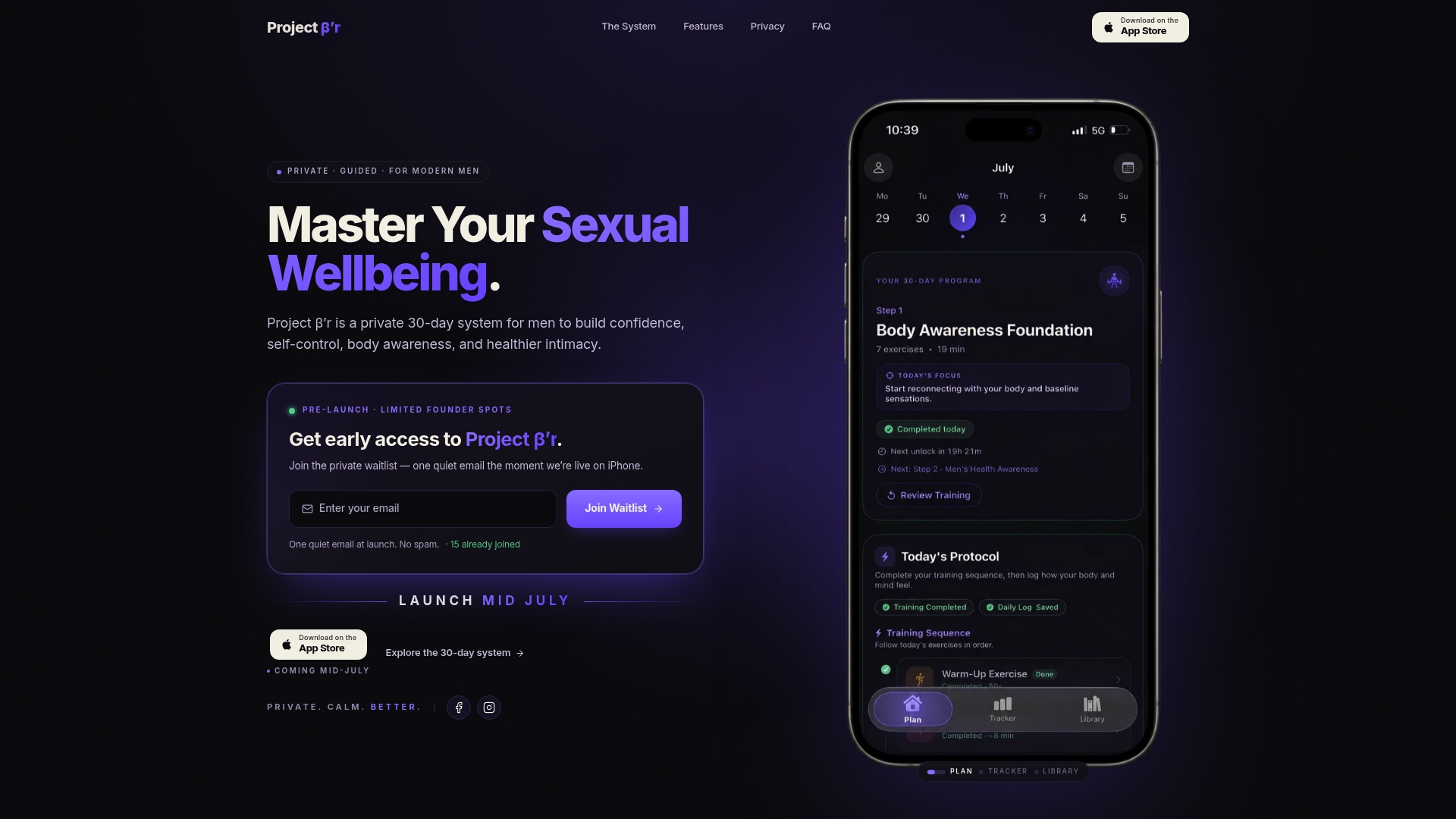
The program combines guided pelvic floor training with daily movement protocols, mood and habit logging, guided audio meditations, and self-reflection tools. Every day has a clear structure, so you are never left guessing what to do next. Progress tracking and self-control monitoring give you a concrete picture of where you are improving, not just a streak counter. If you have been looking for a pelvic health program that respects your privacy, fits your anatomy, and goes beyond kegel counting, Projectbetter is worth a closer look. It is calm, private, and built around gradual, measurable progress.
FAQ
What is the best free pelvic floor app?
Pelvic Floor First is the strongest free option, offering full-body core and pelvic workouts, anatomy visuals, and beginner-to-advanced levels at no cost. It also includes a share feature for working with a physical therapist.
Is the Dr. Kegel app worth it?
Dr. Kegel is a practical choice for people who want flexible session lengths and visual cues without a complex interface. It suits users who prefer to customize their own timing rather than follow a fixed program.
Which app is best for improving pelvic floor health overall?
Squeezy is the most clinically grounded option, with an NHS endorsement, ORCHA Level 3 rating, and a professional mode that lets a physiotherapist build a personalized plan inside the app. For men seeking a program that addresses pelvic floor training alongside sexual wellbeing, Projectbetter’s 30-day structured protocol offers a more targeted fit.
What is the best online pelvic floor program for men?
Most mainstream pelvic floor apps are designed primarily for women. Projectbetter is a private 30-day iOS-based program built specifically for men, combining guided pelvic floor training, daily movement protocols, and mood tracking in a structured, privacy-focused format.
Do pelvic floor apps actually work?
Research shows that app quality varies widely, but apps grounded in clinical guidelines and used consistently can support meaningful improvement. A PubMed study of 90 pelvic floor apps found that the best-performing apps combined clear exercise guidance, privacy protections, and tech support. Apps work best when paired with professional oversight rather than used in isolation.