How to Quit Porn: A Practical Plan for Lasting Change
You can stop or drastically reduce porn use by following a short, structured plan: block access today, map your triggers, build replacement habits, and get accountability. That combination, not willpower alone, is what clinicians describe as sustainable change rather than an on/off moral switch. Recovery is a skill set you build, not a character test you pass or fail.
Here is what to do right now, in order:
- Put your phone in a common area and enable a content filter before you finish reading this article.
- Text one person you trust and tell them you are working on this.
- Pick one replacement activity for tonight’s high-risk window (late evening is the most common trigger).
Projectbetter’s 30-day program was built around exactly this sequence: daily structure, private habit tracking, and guided reflection that compounds over time. The steps below give you the full picture.
Pro Tip: Don’t wait for the “right moment” to start. The single most effective move is the one you make in the next five minutes, not the perfect plan you draft next week.
Key Takeaways
Quitting porn sustainably requires combining immediate friction, trigger awareness, replacement habits, and accountability, not willpower alone.
| Point | Details |
|---|---|
| Block access first | Enable filters and move devices out of private spaces before anything else. |
| Map triggers, not just urges | Identify your highest-risk windows and pre-assign a specific replacement for each. |
| Urges peak and fade | Most cravings crest within 15–20 minutes; a timer and one replacement activity usually gets you through. |
| Address co-occurring issues | Depression, anxiety, and loneliness drive relapse; effective recovery addresses these alongside the behavior. |
| Projectbetter for daily structure | The 30-day iOS program offers private, CBT/ACT-informed daily protocols, habit logging, and progress tracking for men. |
Table of Contents
- How do you know if your porn use is actually a problem?
- Practical steps to stop watching right now
- How to change your routines and pick replacements that actually work
- Why addressing depression, anxiety, and loneliness matters for recovery
- What to expect in early recovery: urges, symptoms, and a rough timeline
- How to plan for relapse prevention before a slip happens
- When to seek professional help and where to find it in the U.S.
- How structured 30-day programs support early recovery
- Projectbetter: a private 30-day program built for this work
- Sources
- FAQ
How do you know if your porn use is actually a problem?
The question isn’t how often you watch. It’s whether watching is costing you something real. Use this checklist to find out.
Score one point for each statement that is true for you right now:
- You have tried to cut back or stop and couldn’t.
- You spend more time than you intended, regularly.
- Porn use is affecting your sleep, work, or concentration.
- You feel shame, guilt, or anxiety after watching, yet return anyway.
- You keep your use secret from people close to you.
- Real-life intimacy feels less satisfying than it used to.
- You use porn to manage stress, loneliness, or low mood.
- You have missed obligations or been late because of it.
Interpreting your score:
- 0–2: Low concern. Monitor, but self-help resources are likely sufficient.
- 3–5: Moderate concern. A structured self-help plan plus accountability is a reasonable first step.
- 6–8: High concern. Consider speaking with a licensed clinician experienced in compulsive sexual behavior alongside any self-help work.
The threshold for “problematic” is life impact, not frequency. A person who watches rarely but feels completely out of control has a more pressing concern than someone who watches more often but maintains full function. That distinction matters clinically.
Pro Tip: Keep a private journal for one week and note every time you feel the urge: what time it was, what you were doing beforehand, and how you felt. Patterns become visible fast, and visibility is the first lever of change.
Practical steps to stop watching right now
These steps are designed to create friction between the urge and the behavior. Friction buys you time, and time is what urge-management skills need to work.
Do this in the next five minutes:
- Move your laptop or tablet out of your bedroom.
- Enable a content filter (Circle, Covenant Eyes, or your router’s parental controls).
- Delete saved bookmarks, browser history, and any apps linked to adult content.
- Sign out of any accounts and remove saved payment methods.
- Change account passwords and give the new password to a trusted person.
Environmental changes to make today:
- Charge your phone in the kitchen or living room, not your bedroom.
- Rearrange your evening routine so the first 20 minutes after dinner involve another person or a physical activity.
- Place a visible cue for your replacement activity where your device usually sits (a book, resistance band, or journal works well).
Account-level actions for this week:
- Cancel subscriptions and request account deletion where possible.
- Set your browser’s safe-search settings to strict.
- Ask your accountability partner to check in with you every evening for the first two weeks.
The UT Dallas Student Counseling Center recommends changing environments and increasing social contact as foundational first moves, and the research supports that framing: automatic behavior depends on consistent cues, and disrupting those cues is faster than relying on willpower.
Pro Tip: Delegate the blocker password to your accountability partner, not yourself. Knowing you can’t easily undo the friction removes the internal debate entirely.
How to change your routines and pick replacements that actually work
Blocking access creates space. What you put in that space determines whether the change holds.
Start by identifying your two or three highest-risk windows. For most people, these cluster around late evenings, periods of boredom or loneliness, and the aftermath of stress or conflict. Map one specific replacement for each:
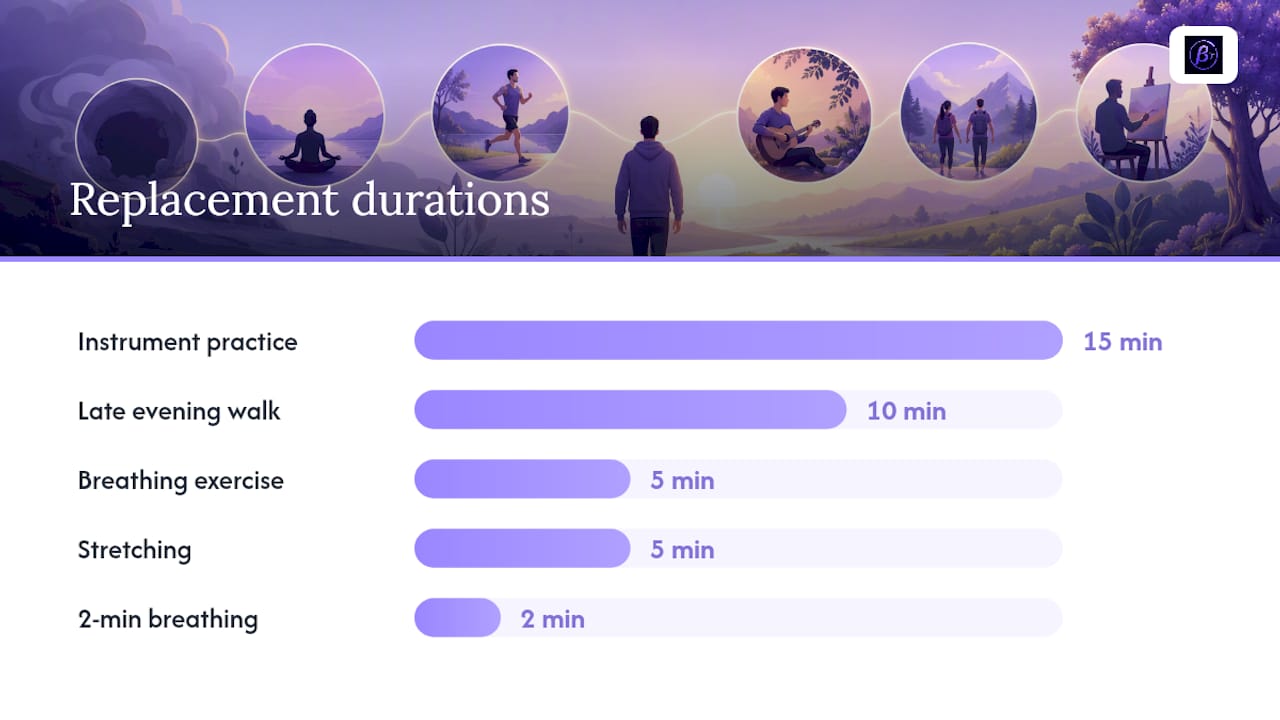
- Late evening, alone: A 10-minute walk outside, followed by a shower and a book in bed.
- Boredom mid-afternoon: A five-minute breathing exercise, then a text to a friend.
- After an argument or difficult conversation: A short, vigorous workout or a call to someone outside the situation.
Effective replacements share three qualities: they are specific (not “do something healthy”), they are immediately available, and they are incompatible with the old behavior. “Call a friend” beats “try to relax” every time because it has a clear action and involves another person.
Habit-stacking makes replacements automatic faster. Attach the new behavior to something you already do reliably: “After I brush my teeth, I put my phone on the kitchen counter.” The existing habit carries the new one.
Across domains, strong replacement options include:
- Physical: Resistance training, running, yoga, a cold shower.
- Social: A scheduled call, a group class, a community meeting.
- Creative: Drawing, writing, playing an instrument for 15 minutes.
- Micro-commitments: A two-minute breathing exercise, a short walk around the block, five minutes of stretching.
The goal is not to fill every moment. It’s to have a pre-decided answer ready when the urge arrives, so you’re not making a decision under pressure.
Pro Tip: Write your trigger map on a card and keep it in your wallet or as a phone wallpaper. When an urge hits, you want the replacement visible before the craving peaks.
Why addressing depression, anxiety, and loneliness matters for recovery
Porn use rarely exists in isolation. Co-occurring mental-health issues, particularly depression, anxiety, and loneliness, are common among people working to reduce compulsive sexual behavior, and treating the behavior without addressing those drivers tends to produce short-lived results.
Three therapy approaches have the strongest clinical support for this work:
Cognitive Behavioral Therapy (CBT) targets the thought patterns that precede and follow porn use: the rationalizations, the shame spirals, and the automatic associations between emotional states and the behavior. It gives you a structured way to interrupt those loops.
Acceptance and Commitment Therapy (ACT) teaches urge tolerance rather than urge suppression. Instead of fighting a craving, you observe it, name it, and let it pass without acting on it. Clinical research consistently shows that CBT and ACT produce large, lasting reductions in problematic pornography use across multiple trials.
Motivational Interviewing helps when ambivalence is the main barrier: part of you wants to stop, part of you doesn’t. A skilled clinician uses this approach to resolve that tension without pressure or judgment.
“Recovery is not about becoming a different person. It’s about building a life where you don’t need the escape as much.” This framing, supported by clinicians who work with compulsive sexual behavior, shifts the goal from suppression to construction.
Practical first steps for mental-health work:
- Screen yourself for depression and anxiety using a validated tool (PHQ-9 for depression, GAD-7 for anxiety, both freely available online).
- Contact a licensed mental-health provider and ask specifically about experience with compulsive sexual behavior.
- If you are having thoughts of self-harm, call or text 988 (the Suicide and Crisis Lifeline) immediately.
Coping skills that complement therapy:
- Mindfulness and urge surfing (observing a craving without acting on it)
- Naming emotions out loud or in writing before reaching for a device
- Structured daily exercise, which reduces anxiety and improves sleep
- Guided meditations designed for urge tolerance and emotional regulation
What to expect in early recovery: urges, symptoms, and a rough timeline
Knowing what’s coming makes it far less likely you’ll interpret normal withdrawal as failure.
Urges typically peak and fade within roughly 15–20 minutes. That is the single most useful fact in early recovery. If you can delay acting for 20 minutes using a timer, a replacement activity, or a call to your accountability partner, the craving will usually pass on its own.
Key stat: Most urges crest within 15–20 minutes. A short timer plus one replacement activity is often enough to get through the peak.
Common early symptoms include irritability, difficulty concentrating, low mood, restlessness, and disrupted sleep. These are normal and temporary.
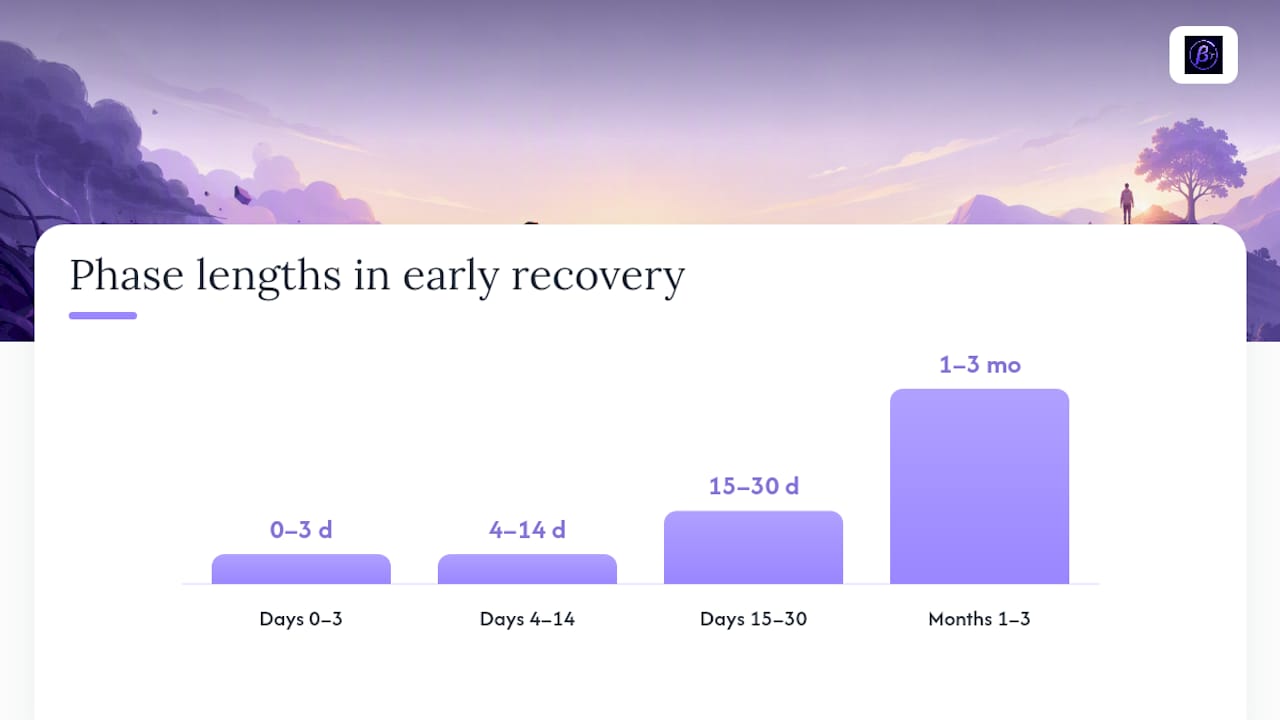
| Phase | What typically happens | What helps |
|---|---|---|
| Days 0–3 | Intense urges, restlessness, possible sleep disruption | Friction tactics, accountability check-ins, short walks |
| Days 4–14 | Urges remain frequent; mood may dip; some brain fog | Replacement activities, sleep hygiene, daily structure |
| Days 15–30 | Urge frequency usually decreases; mood begins to stabilize | Habit tracking, journaling, first therapy session if needed |
| Months 1–3 | Cravings become more manageable; new routines solidify | Continued accountability, relapse-prevention planning |
A few practical moves for each phase:
- Days 0–3: Set a 20-minute timer the moment an urge arrives. Do not negotiate with it.
- Days 4–14: Prioritize sleep. Fatigue is one of the strongest relapse triggers.
- Days 15–30: Begin tracking mood and urge frequency in a habit log. Patterns become your data.
- Months 1–3: Review your trigger map monthly and update it as your life changes.
Progress is rarely linear. A harder day in week three doesn’t erase week two.
How to plan for relapse prevention before a slip happens
A relapse-prevention plan works best when you write it before you need it, not after a slip.
Core relapse-prevention checklist:
- List your top three triggers and the specific replacement for each.
- Write down two people you will contact immediately if you feel close to relapsing.
- Define what a “slip” means to you and how you will respond (one slip is data, not defeat).
- Schedule a weekly check-in with your accountability partner.
- Identify one professional resource you will contact if self-help isn’t enough.
Accountability structures that work:
- A trusted friend or partner who knows your goal and checks in regularly.
- A therapist who tracks your progress across sessions.
- A peer support group where you report in weekly, in person or online.
The key with accountability is specificity. “Tell me how you’re doing” is less effective than “Text me every evening at 9 PM with a one-word check-in.” Clear agreements reduce the awkwardness and increase follow-through.
Simple tracking tools:
- A habit log (paper or app) where you mark each day and note urge intensity.
- A mood journal that captures emotional state before and after high-risk windows.
- A streak tracker, used carefully: the goal is progress, not a perfect score that makes a single slip feel catastrophic.
When a slip happens, treat it as information. Ask: What triggered it? What was different that day? What will you do differently next time? That analysis, done calmly and without self-punishment, is what separates a slip from a full relapse.
When to seek professional help and where to find it in the U.S.
Self-help works well for many people, particularly those earlier in the problem continuum. Professional support becomes the right call when:
- You have tried to stop multiple times and the pattern keeps returning.
- Porn use is causing significant impairment at work, in relationships, or in daily function.
- You are using other substances alongside porn to manage emotions.
- You are experiencing thoughts of self-harm.
What to ask a clinician:
- Do you have experience treating compulsive sexual behavior or problematic pornography use?
- Which therapy approaches do you use (CBT, ACT, motivational interviewing)?
- What does an initial assessment look like, and how do you measure progress?
U.S. resources to contact now:
- Sex Addicts Anonymous (SAA): Saa-recovery — in-person and online meetings across the U.S.
- Porn Addicts Anonymous: Pornaddictsanonymous — peer-run, anonymous, recurring meetings.
- SLAA (Sex and Love Addicts Anonymous): slaaFWS.org — 12-step meetings with a broader scope.
- Psychology Today therapist finder: Filter by “sexual addiction” or “compulsive sexual behavior.”
- Crisis line: Call or text 988 for immediate mental-health support.
For your first therapy session, bring your self-assessment score, a brief note on how long the pattern has been present, and any co-occurring concerns (sleep, mood, relationship strain). That context helps a clinician assess accurately and quickly.
How structured 30-day programs support early recovery
A structured program does something that willpower and good intentions alone cannot: it gives you a daily decision already made. You don’t have to figure out what to do today. The protocol tells you.
Evidence-based 30-day plans that combine trigger mapping, friction tactics, replacement activities, and relapse-prevention have shown real early momentum for people in the self-help range. The structure itself is part of the mechanism.
When evaluating any structured program, look for:
- Daily tasks that are specific and immediately doable (not vague goals).
- A clinical basis in CBT or ACT principles.
- Private, judgment-free tracking so you can be honest with yourself.
- Progress metrics you can actually see week over week.
- Exercises that address the body, not just the mind (movement and breathwork reduce anxiety and improve self-regulation).
Who benefits most from a private 30-day program: men who want structured daily guidance without the exposure of a group setting, who are in the self-help to moderate range on the checklist above, and who want measurable progress rather than open-ended reflection.
Projectbetter maps directly to those criteria. The program includes daily movement protocols, guided pelvic floor training, audio meditations for urge tolerance, mood and habit logging, and self-reflection tools, all within a private iOS app. It’s built for men who want a calm, structured path forward without shame or pressure.
Recovery is about building a life, not flipping a switch
The conventional framing of porn addiction as a moral failing, something you either have or don’t, creates a trap. It makes every slip feel like proof that you are broken. It makes asking for help feel like an admission of weakness. And it keeps the focus on suppression rather than construction.
What the clinical evidence actually supports is different: sustainable change comes from building skills, restructuring environments, addressing underlying emotional drivers, and connecting with others who understand the work. Willpower is a resource that depletes. Structure, community, and practiced coping skills do not.
Setbacks are part of the process, not evidence that the process has failed. A slip tells you something about your triggers, your current stress load, or a gap in your plan. That information is useful. Self-punishment is not.
The most durable recoveries we see are built quietly, one day at a time, by people who stopped waiting to feel ready and started making small, concrete changes instead. You don’t need to be certain this will work. You just need to take the next step.
Projectbetter: a private 30-day program built for this work
Most men working to reduce porn use want two things: a clear daily structure and complete privacy. Projectbetter delivers both through a 30-day iOS app that guides you through daily protocols without requiring you to share your story in a group or explain yourself to anyone.
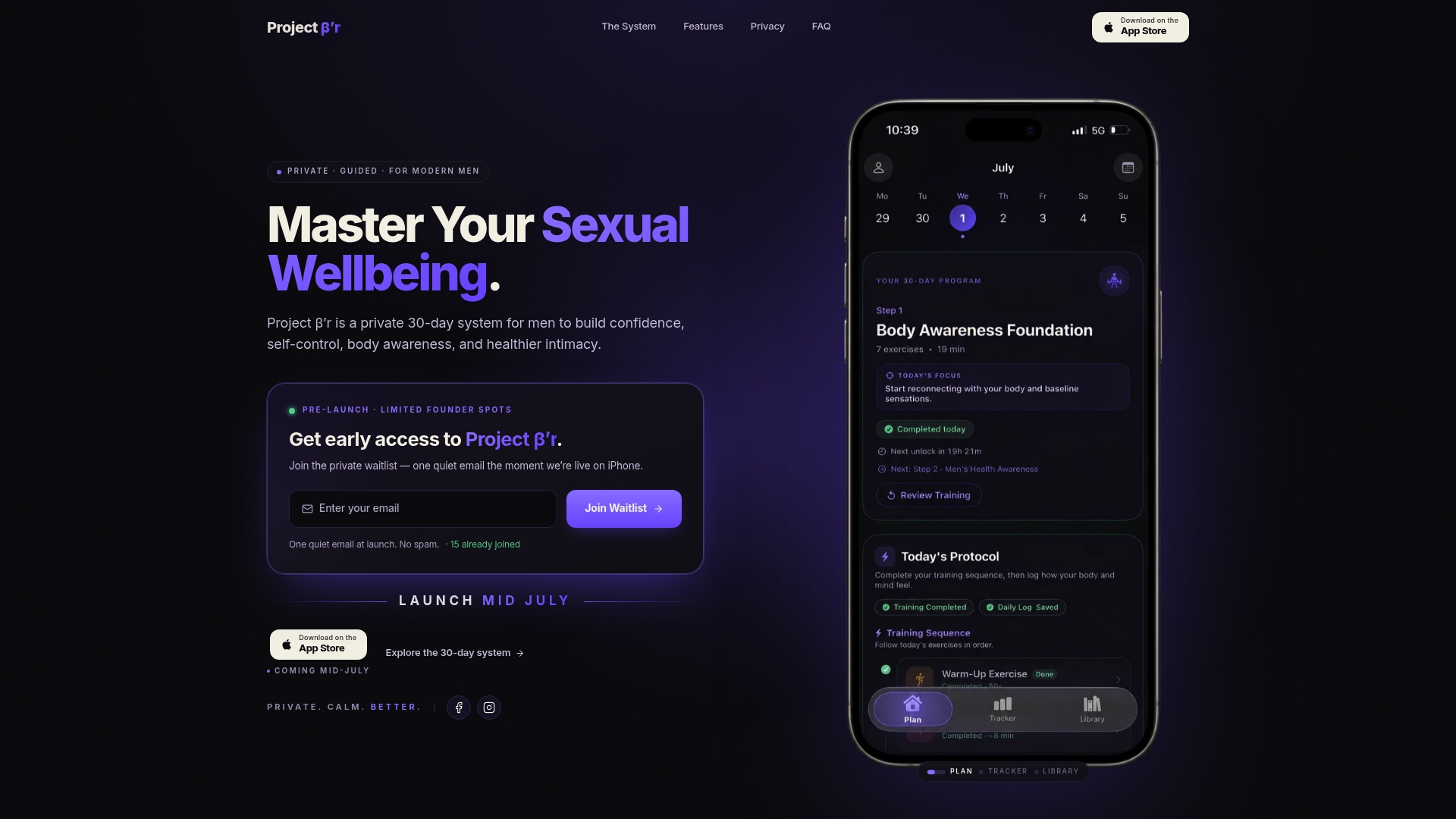
The program includes daily movement exercises, guided pelvic floor (Kegel) training, audio meditations for urge tolerance, mood and habit logging, and self-reflection tools designed around the same CBT and ACT principles that clinical research supports. Progress is tracked privately, and the daily structure removes the guesswork from early recovery.
Projectbetter suits adult men who want a structured, measurable path forward, whether they are in the self-help range or using the program alongside therapy. A free trial is available on iOS, with weekly, monthly, and annual subscription options. Visit Projectbetter to start your free trial and see the full program.
Sources
These resources are vetted, U.S.-focused, and available now:
- This Olympian curbed his unhealthy porn habit - here are the signs and steps to recovery - BBC News
- PMC article summarizing treatment outcomes for problematic sexual behaviors
- Pornography Addiction – Student Counseling Center | UT Dallas
- How to Stop Watching Porn - A Step-by-Step Plan
- Porn Addiction Recovery: 30-Day Evidence-Based Action Plan
- Pornaddictsanonymous
This article provides general information and is not a substitute for professional medical or mental-health advice. If you are experiencing significant distress or impairment, please consult a licensed clinician.
FAQ
What causes compulsive porn use?
Compulsive pornography use is typically driven by a combination of factors: stress, depression, loneliness, anxiety, and the brain’s reward response to novel sexual stimuli. Co-occurring mental-health issues are common and usually need to be addressed alongside the behavior itself.
How do I stop watching adult content on my phone?
Enable a content filter (such as Covenant Eyes or your carrier’s parental controls), move your phone out of your bedroom at night, delete saved bookmarks and apps, and give the filter password to a trusted person so you can’t easily disable it yourself.
How long does it take for urges to get easier?
Most urges peak within roughly 15–20 minutes and begin to decrease in frequency after the first two to four weeks of consistent effort. By months one to three, most people find cravings are noticeably more manageable, though individual timelines vary.
When should I see a therapist instead of using self-help?
Seek professional support if you have tried to stop multiple times without success, if porn use is causing significant impairment at work or in relationships, or if you are experiencing thoughts of self-harm. CBT and ACT are the therapy approaches with the strongest clinical evidence for this issue.
Can a structured app program actually help?
Yes, particularly for men in the self-help to moderate range. Structured daily programs that combine trigger mapping, replacement activities, habit logging, and evidence-based exercises, like Projectbetter’s 30-day iOS program, provide the daily structure and private accountability that make early change more sustainable.