Breaking Impulsive Habits in Relationships: 2026 Guide
TL;DR:
- You can stop reactive relationship patterns by naming escalation aloud and using a scripted pause signal.
- Daily regulation drills and log tracking help break impulsive responses and build emotional awareness.
You can stop reactive relationship patterns with four steps you can start today: (1) name the escalation aloud, (2) send a scripted pause signal, (3) log the trigger plus one alternative action, and (4) run a 60-second regulation drill before re-engaging. These steps draw directly from Gottman’s Four Horsemen framework, where contempt is the single strongest predictor of relationship dissolution, and from the Trigger Log method, a clinical tool for converting reactive impulses into deliberate choices.
- Name it: “I’m getting escalated. I need a few minutes.”
- Pause signal: “I’m not ignoring you. Give me 20 minutes, then I’ll come back to this.”
- Log it: timestamp, trigger phrase, body sensation, automatic thought, alternative action.
- Regulate: four slow breaths, a brief walk, or a short pelvic-floor hold to lower arousal.
Pro Tip: Write your pause script on a phone note right now. Having the exact words ready means you won’t blank when you need them most.
Table of Contents
- Are your reactions impulsive episodes or a self-reinforcing pattern?
- Daily practices that interrupt impulsive relationship behavior
- How to involve your partner without fueling the loop
- Regulation techniques, progress metrics, and a realistic timeline
- When should you seek professional help?
- Why these steps work: the clinical basis
- Key Takeaways
- A 30-day structured approach builds more than impulse control
- Projectbetter offers a private, structured path forward
- Useful sources and therapist directories
- FAQ
Are your reactions impulsive episodes or a self-reinforcing pattern?
Episodic reactivity happens occasionally under stress. A pattern is different. It repeats, escalates, and follows a predictable loop, often the pursuit-withdrawal cycle where one partner chases and the other retreats, each move making the next one worse.
Check yourself against these signs:
- You feel a sudden surge of heat, jaw tightness, or chest pressure before you react.
- You interrupt, go silent, or send a flurry of texts within seconds of feeling threatened.
- The same argument replays with different surface content but the same emotional shape.
- After intimacy or closeness, you pick a fight or pull away without knowing why.
- Impulsive behavior shows up as emotional outbursts, rash decisions, or sudden emotional withdrawal.
Three weekly journal prompts to build your Trigger Log data:
- What was the exact phrase or moment that set me off this week?
- Where did I feel it in my body first, and how long did the sensation last?
- What did I do, and what would I do differently with 20 more seconds?
Two common patterns in men working on sexual confidence: one is the man who goes cold after sex, reading his partner’s quiet mood as rejection and withdrawing before he can be hurt. The other is the man who pushes for reassurance after any emotional distance, texting repeatedly until the silence feels unbearable. Both loops are driven by the same fear; only the direction differs.

Daily practices that interrupt impulsive relationship behavior
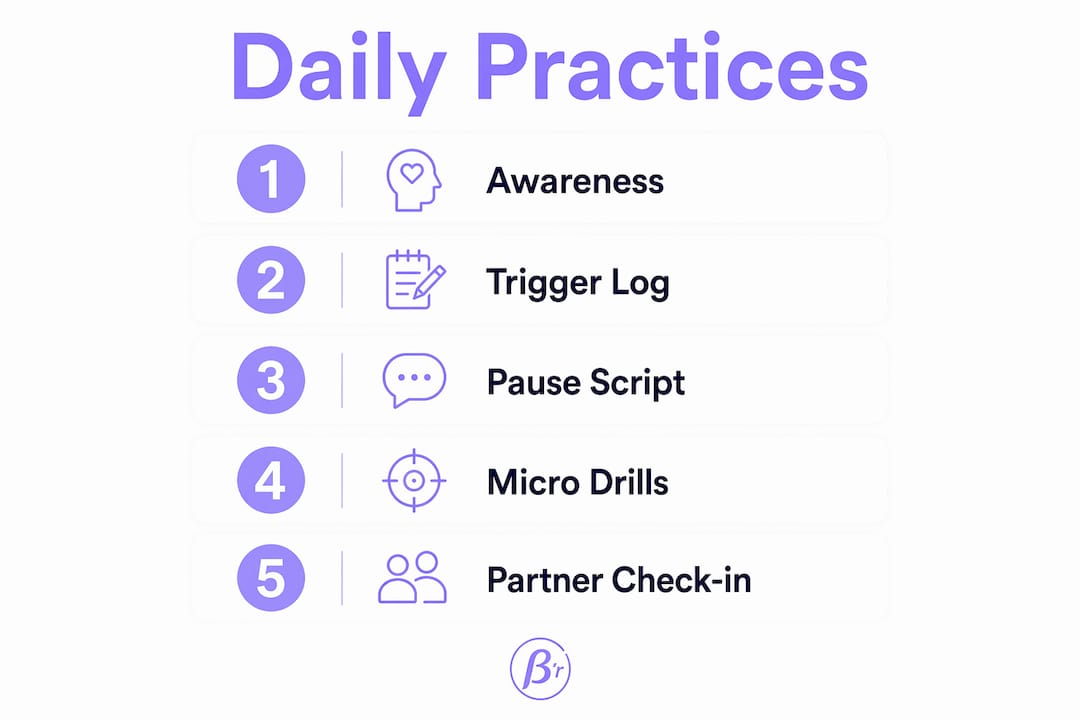
The Trigger Log template
Use this five-field entry every time you feel the urge to react:
| Field | What to write |
|---|---|
| Timestamp | Day, time, and setting |
| Trigger phrase | The exact words or action that set you off |
| Body sensation | Heat, tightness, shallow breath, clenched jaw |
| Automatic thought | The first “ugly” interpretation |
| Alternative action | One concrete thing you did or will do instead |
Review your log every Sunday. Patterns usually cluster around specific times, topics, or contexts.
Pause and naming scripts
These are formatted for quick recall under stress:
- “I’m feeling flooded. I need 20 minutes, then I’ll come back.”
- “I’m not shutting down. I just need space to think clearly.”
- “I notice we’re both escalating. Can we pause and try again at [specific time]?”
Naming escalation aloud signals safety rather than defeat. It prevents the cascade from worsening when paired with an explicit return promise.
Micro-regulation drills
- Breath drill (60 seconds): Inhale for four counts, hold for four, exhale for six. Repeat four times.
- Movement reset: A brisk two-minute walk or ten jumping jacks lowers cortisol faster than sitting still.
- Pelvic-floor hold: A slow five-second Kegel contraction, released fully, repeated three times. This supports sexual confidence and builds the body-awareness that makes somatic interrupts possible.
Track your win rate weekly: how many times did you choose the alternative action over the reactive one? Dropping from five reactive episodes a week to two is a real, measurable win.
How to involve your partner without fueling the loop
The pursuit-withdrawal pattern is systemic. Treating it as one person’s flaw keeps both partners stuck. Reframing it as a shared problem you face together shifts the dynamic from adversarial to collaborative, a move supported by clinical research on repeating relationship patterns.
Mutual-agreement script for pauses: Dos and don’ts:
| Do | Don’t |
|---|---|
| Name the pause and give a return time | Go silent without explanation |
| Send a brief safety signal within 10 minutes | Use withdrawal as leverage |
| Propose a specific repair within 24–72 hours | Make vague promises to “do better” |
| Use “I feel” statements | Lead with criticism or blame |
Role-play contrast: Your partner says they feel ignored. Escalating response: silence, then leaving the room. Effective response: “I hear that. I’m feeling defensive right now, so give me ten minutes and I’ll come back ready to actually listen.” The second response keeps the intimacy connection intact even during conflict.
Small, consistent relationship reminders and micro-check-ins between difficult conversations can also help both partners feel safe enough to stay in the process.
Regulation techniques, progress metrics, and a realistic timeline
Physiological arousal takes a minimum of about 20 minutes to return near baseline. Trying to resolve conflict before that window closes usually makes things worse. Short pauses must be non-ruminative and announced to prevent abandonment fears.
What to track:
- Frequency of reactive episodes per week
- Win rate: alternative actions chosen vs. reactive responses
- Partner-reported sense of safety (a simple weekly 1–10 check-in works)
30-day milestone table:
| Week | Focus | Milestone |
|---|---|---|
| 1 | Awareness | Trigger Log started; pause script memorized |
| 2 | Interruption | Win rate above 40% on reactive episodes |
| 3 | Repair | Reach-and-Repair used at least twice; partner reports feeling safer |
| 4 | Consistency | Reactive episodes down; daily regulation drill is automatic |
Daily pelvic-floor micro-exercises (three sets of slow five-second holds) build the body-awareness that makes somatic interrupts faster and more reliable, while also directly supporting sexual confidence over the 30-day period.
When should you seek professional help?
Some patterns need more than self-guided tools. Escalate to individual therapy, couples therapy, or sex therapy when you notice:
- Contempt (eye-rolling, mockery, character attacks) appearing regularly.
- Repeated threats of breakup used as leverage during arguments.
- Violence, coercion, or partner safety concerns of any kind.
- Habitual infidelity tied to impulsive decision-making.
- Self-guided tools applied for four or more weeks with no measurable change.
Therapist vetting checklist:
- Evidence-based training: Emotionally Focused Therapy (EFT), Gottman Method, or Cognitive Behavioral Therapy (CBT).
- Sex-therapy credentials (AASECT-certified) if sexual confidence or intimacy is part of the work.
- Willingness to review your Trigger Log and set measurable session goals.
Bring your Trigger Log summary, a list of recurring episode dates, and a clear statement of your relationship goals to the first session. It saves time and signals that you are already doing the work. Therapeutic approaches including Mindfulness-Based Cognitive Therapy (MBCT), Nonviolent Communication (NVC), and somatic regulation work are all well-supported for relationship impulsivity.
Why these steps work: the clinical basis
The Four Horsemen cascade moves in a predictable order: criticism leads to defensiveness, defensiveness leads to stonewalling, and stonewalling creates the conditions for contempt. Contempt is the endpoint and the hardest to reverse, which is why interrupting at the criticism stage is far more efficient than waiting.
The nervous-system mechanism:
- During a reactive flood, the brain prioritizes survival over reflective thought.
- Somatic awareness, tracking heat, tightness, or breath changes, is the earliest reliable interrupt because it engages interoceptive labeling before the cognitive spiral begins.
- Naming the escalation aloud activates the prefrontal cortex, the part of the brain responsible for deliberate choice.
Tool-to-evidence mapping:
| Tool | Clinical basis |
|---|---|
| Trigger Log | CBT behavioral tracking; converts reactive loops into conscious choice points |
| Pause scripts | Co-regulation and de-escalation; prevents contempt cascade |
| Somatic drills | Interoceptive labeling; interrupts survival-driven reactivity |
| Reach-and-Repair | Attachment repair; prevents resentment from compounding |
| five-to-one appreciation target | Gottman ratio for rebuilding positive interaction patterns |
Key Takeaways
Breaking impulsive habits in relationships requires naming escalation early, logging triggers consistently, and practicing short daily regulation drills before reactive patterns solidify into contempt.
| Point | Details |
|---|---|
| Name escalation immediately | Say “I’m getting escalated, I need 20 minutes” to prevent the contempt cascade. |
| Start a Trigger Log today | Record timestamp, trigger phrase, body sensation, and one alternative action after every reactive episode. |
| Honor the 20-minute rule | Physiological arousal takes at least 20 minutes to settle; problem-solving before then usually backfires. |
| Use Reach-and-Repair | Send a safety signal within 10 minutes of withdrawing; name the behavior within 24–72 hours. |
| Projectbetter 30-day program | Projectbetter’s daily protocols, habit tracking, and pelvic-floor exercises map directly to these tools in a structured private format. |
A 30-day structured approach builds more than impulse control
The conventional advice on relationship impulsivity focuses almost entirely on communication scripts. Scripts matter, but they are the last five percent of the work. The first ninety-five percent is physiological: learning to read your own body before your mouth or your silence does the damage.
That is why a 30-day structure works better than a list of tips. Repetition builds the neural pathways that make regulation automatic. The pelvic-floor work is not incidental to this process. It builds body awareness from the inside out, the same awareness that lets you catch a flood signal before it becomes a reactive episode. Men who combine regulation practice with sexual-confidence work tend to see both improve together, because the underlying skill is the same: staying present in your own body without bracing against it.
Setbacks are part of the process, not evidence that it is not working. The goal is not a perfect 30 days. It is a measurable trend. If your win rate improves week over week, you are on the right path. Keep your Trigger Log private and honest. Involve your partner in the pause agreements, but keep your internal regulation work your own responsibility.
Projectbetter offers a private, structured path forward
If you want the tools in this guide organized into a daily program you can follow without building the structure yourself, Projectbetter’s 30-day program delivers exactly that. Each day includes a short movement protocol, guided pelvic-floor exercises, a Trigger Log prompt, and a brief audio reflection, all inside a private iOS app with no public profile and no shared data.
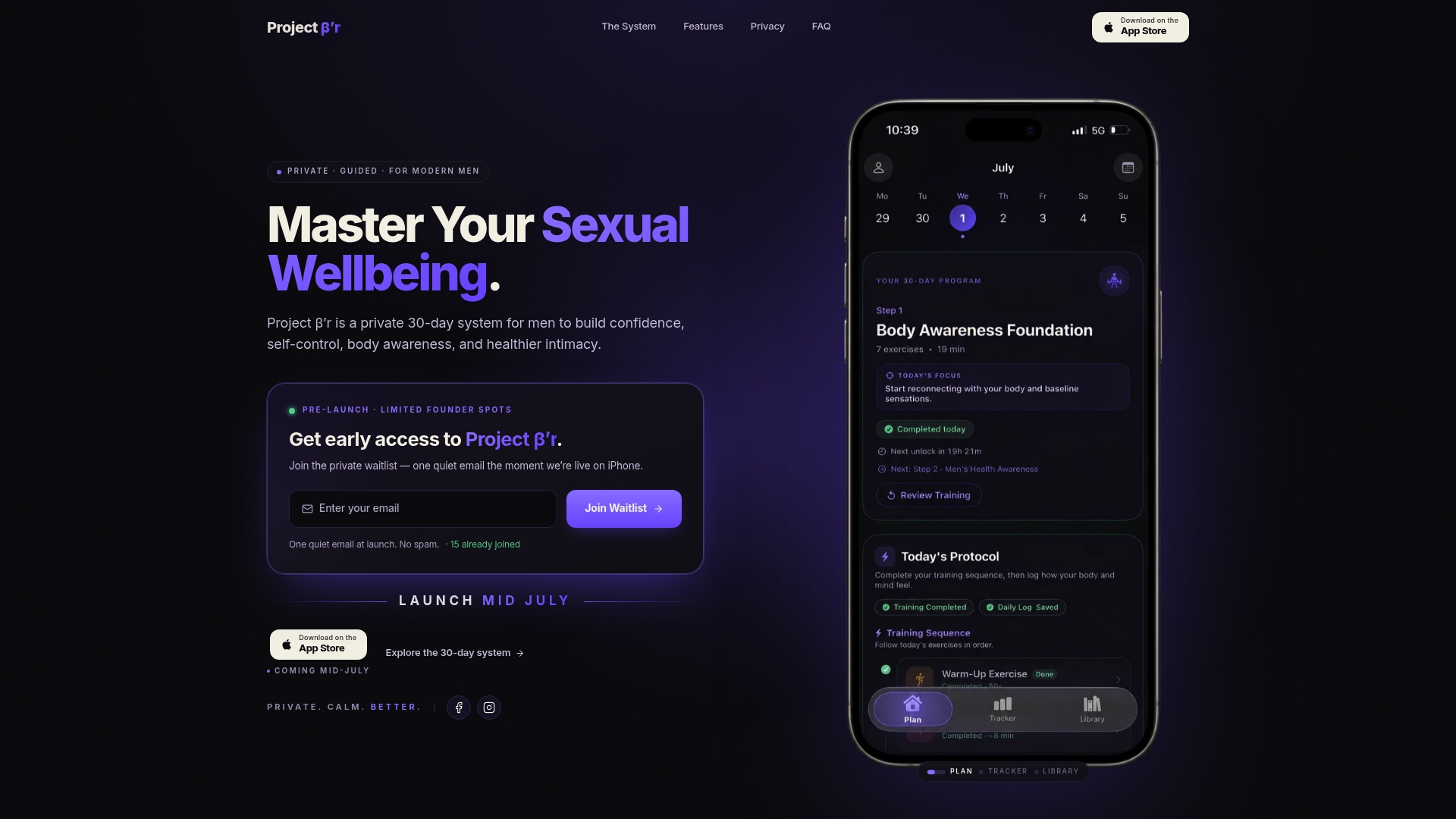
The habit tracker inside the app maps directly to the win-rate metric described in this guide. The daily challenges move week by week through the same awareness-to-repair arc outlined in the 30-day milestone table above. Subscription options include weekly, monthly, and annual plans, so you can start with a short commitment and extend when you see results.
Start your free trial and run the first seven days alongside the Trigger Log you started today.
Useful sources and therapist directories
- Gottman Four Horsemen framework — contempt, criticism, defensiveness, stonewalling
- Trigger Log and Reach-and-Repair protocol
- Pursuit-withdrawal and repeating patterns
- Co-regulation and de-escalation scripts
- Somatic awareness and self-sabotage
- Innovative couples therapy approaches (MBCT, NVC, EFT)
- Impulsivity in relationships: clinical overview
- Therapist directories: Psychology Today therapist finder, AASECT sex therapist directory, EFT therapist locator via ICEEFT
When searching, filter for EFT, Gottman Method, CBT, or AASECT credentials. Bring your Trigger Log export to the first session.
This article is general wellness information, not professional medical or psychological advice. For your specific situation, consult a licensed therapist or qualified healthcare provider.
FAQ
What is the fastest way to stop an impulsive reaction mid-argument?
Name the escalation aloud (“I’m getting flooded, I need 20 minutes”) and step away. Physiological arousal takes at least 20 minutes to settle, so a timed, announced pause is more effective than pushing through.
How long does it take to break impulsive relationship habits?
Most people see a measurable drop in reactive episodes within two to four weeks of consistent Trigger Log use and daily regulation practice. A full 30-day cycle typically produces noticeable changes in both frequency and partner-reported safety.
Can pelvic-floor exercises actually help with relationship impulsivity?
Yes, indirectly. Pelvic-floor work builds somatic awareness, the ability to read body signals early, which is the same skill that lets you catch a flood response before it becomes a reactive episode. Projectbetter’s daily protocols combine both.
When does impulsive behavior in a relationship require therapy?
Seek professional help when contempt appears regularly, when threats of breakup are used as leverage, when self-guided tools show no improvement after four weeks, or when any safety concern is present.
What is the Reach-and-Repair protocol?
It is a three-step repair sequence: send a brief safety signal within 10 minutes if you withdraw or shut down, name the behavior and propose a specific fix within 24–72 hours to prevent resentment from building.