Building Intimacy in Couples: Practical Strategies for 2026
TL;DR:
- Building intimacy in couples involves ongoing efforts across emotional, physical, cognitive, and experiential dimensions. Small, consistent actions like daily touch, turning toward connection bids, and shared rituals rebuild trust and closeness over time.
Building intimacy in couples is not a single act or a single conversation. It is a practice across four interconnected dimensions: emotional, physical, cognitive, and experiential. Clinical frameworks describe intimacy as an ecosystem where neglecting even one dimension creates systemic disconnection that can feel like falling out of love. The good news is that small, consistent actions rebuild what distance erodes.
Here are the highest-impact starting points, grounded in psychological and neurobiological research:
- Non-sexual touch daily: A six-second hug triggers oxytocin release, calming both nervous systems and building trust without a word spoken.
- Turn toward bids for connection: Gottman’s research shows couples who stay together respond to each other’s bids for connection 86% of the time, while couples who divorced turned toward those bids only 33% of the time.
- Practice vulnerability in small steps: Share a fear, admit a mistake, or name what you are feeling right now.
- Create rituals: Phone-free coffee, a nightly check-in question, a shared walk. Recurring moments signal “we have something that is ours.”
- Relinquish control: Attempting to manage your partner’s choices creates distance. Letting go opens space for mutual responsibility.
- Stay curious: Ask questions you genuinely do not know the answer to. Your partner is still becoming someone new.
How emotional intimacy develops in a relationship
Emotional intimacy is not a feeling that arrives on its own. It is built through a cycle: one partner discloses something meaningful, the other perceives it accurately, and responds with care. All three steps must complete. Disclosure without a caring response produces nothing. A caring response to something misunderstood produces frustration.
John Gottman’s decades of research identified “bids for connection” as the atomic unit of emotional closeness. A bid can be as small as pointing at something on TV or sharing a minor frustration from the day. Couples who stayed together turned toward those bids 86% of the time, while couples who divorced turned toward those bids only 33% of the time. The gap is not grand romantic gestures. It is thousands of small moments of paying attention.
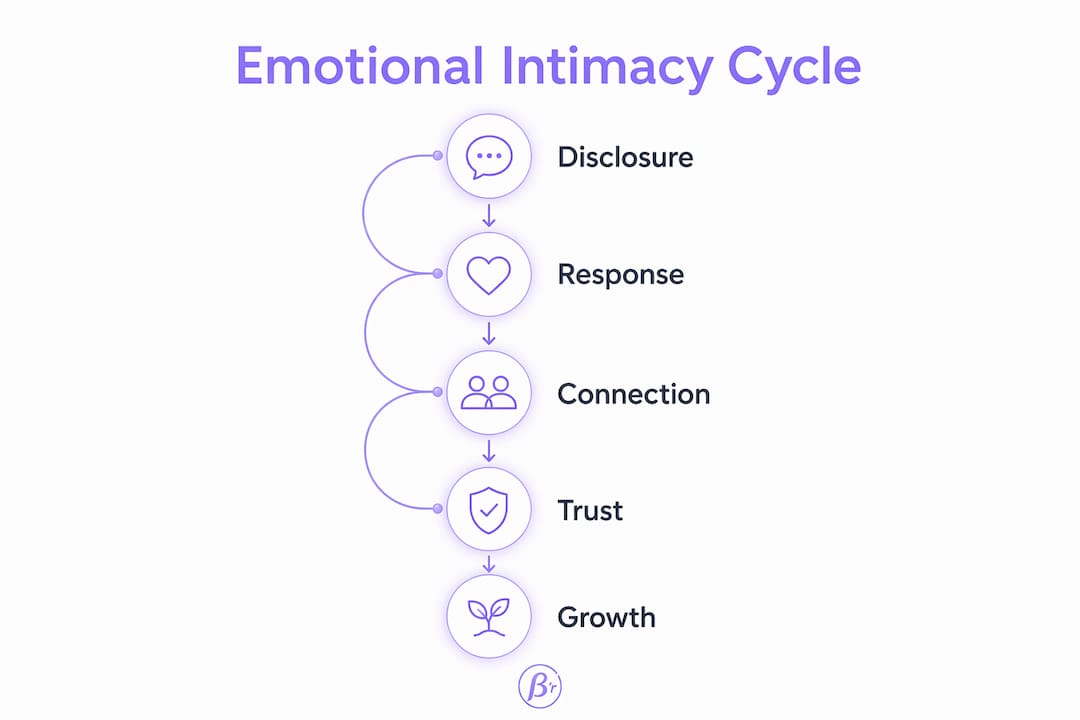
Vulnerability is the other engine. Researcher Brené Brown’s work identifies it as the single most essential ingredient in deep connection. Most people have learned, through experience, that emotional exposure is risky. So they protect themselves with humor, intellectualizing, or performed strength. The wall that protects you from being hurt also prevents you from being truly known.
Practical ways to build emotional closeness:
- Update your love map: Ask what your partner is most worried about right now, not what they were worried about last year. People change.
- Express specific appreciation: “When you kept your composure during that hard conversation with your family, I felt proud to be with you” lands differently than “you’re amazing.”
- Share a fear related to the relationship, not a general one. Relational vulnerability deepens the bond faster.
- Admit when you are wrong without minimizing it. Modeling humility creates safety for your partner to do the same.
Couples who maintain a strong positive sentiment reserve, built through daily appreciation and genuine curiosity, handle conflict far better than those who let that reserve deplete.
What physical intimacy actually requires
Physical intimacy starts well before the bedroom. It starts with a hand on the shoulder as you pass in the kitchen, with holding hands on a walk, with sitting close on the couch without an agenda. These are not trivial gestures. They are the nervous system’s daily dose of co-regulation.

The neurobiology is specific: a six-second hug is approximately the minimum duration for oxytocin release. Oxytocin lowers physiological stress responses and increases feelings of trust and security. Without regular non-sexual touch, the entire physical dimension of a relationship operates at a deficit, and sexual desire cannot reliably re-emerge from that deficit.
The nervous system calms through proximity and stillness, not through negotiation or effort of will. Sitting with legs touching, sleeping in the same bed even without contact, a real greeting hug when you get home. These acts tell the nervous system that this relationship is a source of safety, not threat. When that signal is consistent, desire follows naturally.
Daily habits that restore physical closeness:
- Hold the hug for a full six seconds at least once a day.
- Make physical contact without it leading anywhere. Touch with no agenda.
- Sit close during low-key evenings instead of opposite ends of the couch.
- Hold hands during walks or while waiting somewhere.
- After any intense or vulnerable moment, offer aftercare through touch: a hand, a blanket, quiet presence. Without effective landing after vulnerability, the brain can file the experience as “dangerous,” making future openness harder.
Daily rituals that keep connection alive
Rituals of connection are recurring activities that carry relational meaning. They do not need to be elaborate. What makes them work is that they are consistent and protected from the erosion of busy schedules.

2026 relational research highlights these habits as buffers against relationship stress and the depletion of positive sentiment. Couples with established daily rituals report higher satisfaction and fewer conflicts than those without them. The ritual signals: we chose this, and we keep choosing it.
Effective rituals couples use:
- Morning coffee together without phones, even fifteen minutes.
- A nightly check-in question before sleep: “What was the best part of your day?” or “Is there anything you need from me right now?”
- A particular greeting when one partner comes home, held long enough to actually reconnect.
- A weekly walk with no destination agenda.
- A shared meal cooked together once a week.
Pro Tip: Start with one ritual, not five. Pick the one that fits your existing schedule most naturally and protect it for three weeks before adding another. Consistency matters more than variety.
The couples who sustain intimacy over decades are not lucky. They are intentional. They treat shared time with the same seriousness they give a work commitment. Every week without a deliberately chosen shared moment is a week the “we” gets a little quieter.
Common challenges in building intimacy and how to work through them
The most common intimacy barriers are not dramatic. They are habitual. Pursuer-withdrawer cycles, controlling behaviors, and fear of vulnerability quietly erode connection over months and years before couples recognize the pattern.
Control is one of the most underestimated intimacy killers. Therapeutic models show that control attempts are almost always fear-based safety strategies: fear of disappointment, fear of rejection, fear of losing the relationship. The problem is that control sends a message to your partner that you know better than they do what is right for them. That message creates distance, not safety. Relinquishing inappropriate control opens a space for your partner to demonstrate greater responsibility, and frees you to focus on your own self-care and growth.
Research from 2025 shows that outside friendships and personal pursuits protect couples from the pressure of expecting one person to meet every need. Passion thrives when partners weave between periods of self-expansion and reconnection. Too much togetherness without individual growth leads to over-familiarity and resentment.
Pro Tip: When you notice yourself about to correct, redirect, or manage your partner’s choice, pause. Ask yourself: is this my circle of control? If not, let it go and notice what happens in the space that opens up.
Common challenges and practical responses:
- Pursuer-withdrawer cycles: Both partners need to recognize the cycle itself is the problem, not each other. The pursuer stops framing distance as criticism. The withdrawer stops disappearing when things get uncomfortable.
- Fear of vulnerability: Start smaller than feels necessary. Share something slightly more personal than comfortable, observe the response, and calibrate from there.
- Nervous system threat responses: You cannot think your way back to closeness. Regulate first through proximity and stillness, then talk.
- Unclear boundaries: Explicitly stating what you need and what you cannot accept paradoxically creates more safety, not less. Clear limits reduce the background threat calculations that keep partners guarded.
For couples navigating control dynamics in therapy, structured professional support can accelerate the process of breaking these ingrained patterns.
How to practice intimacy-building skills together
Intimacy is a skill set, not just a feeling. Like any skill, it develops through deliberate practice, not through waiting for the right mood.
Start with curiosity. Ask questions you genuinely do not know the answer to: “What are you most worried about right now that you haven’t told me?” or “Is there something you want that you haven’t asked for?” These are not interrogations. They are invitations into your partner’s current inner world, not the version you think you already know.
Shared novelty is another underused tool. Psychologist Arthur Aron’s research shows that people experience emotional intimacy when they expand their sense of self through the relationship. Doing something genuinely new together, not just something fun but something neither of you has done before, activates the brain’s reward system in ways that routine activities cannot. Cook a cuisine you have never attempted. Take a class in something neither of you knows. Walk a trail you have never walked.
Practical exercises for couples to try:
- Vulnerability rounds: Each partner shares one thing they have been holding back, then the listener reflects it back without fixing or minimizing.
- Love map updates: Once a week, ask one question about your partner’s current inner life that you do not already know the answer to.
- Presence practice: Put the phone in another room for the first thirty minutes after you are both home. No exceptions for one week and see what shifts.
- Shared challenge: Choose one physical or creative challenge to tackle together. Shared difficulty builds “we are a unit” circuitry that shared leisure cannot reach.
- Appreciation ritual: Each evening, name one specific thing your partner did that you noticed and valued.
Review your practices every few weeks. What is working? What has become automatic and lost its meaning? Adjust without judgment.
How past trauma shapes intimacy and what to do about it
Past trauma does not stay in the past. It lives in the nervous system and shapes how safe closeness feels in the present. A partner who grew up in an environment where emotional exposure led to ridicule or punishment will have learned, at a deep level, that vulnerability is dangerous. That learning does not disappear because the relationship is now safe. It has to be gradually updated through repeated experiences of disclosure met with care.
Trauma responses in intimacy often look like avoidance, emotional shutdown, or sudden withdrawal during moments of closeness. These are not character flaws. They are protective adaptations that once made sense and now create distance. Recognizing this in yourself or your partner changes the frame from “why won’t you open up?” to “what would make it feel safer to try?”
The path forward is slow and patient. Pushing for more vulnerability than the nervous system can tolerate at a given moment reinforces the threat signal rather than reducing it. Small, consistent experiences of safety, where disclosure is met with warmth and nothing bad happens, gradually recalibrate the threat response. This is why co-regulation through physical presence matters so much: the body needs to learn safety before the mind can fully follow.
Professional support from a trauma-informed couples therapist can provide the structure and pacing that self-guided efforts sometimes cannot. If one or both partners carry significant relational trauma, that is not a reason to give up on intimacy. It is a reason to get skilled help.
Why shared goals and values deepen connection
Couples who are building something together have a different quality of closeness than couples who are simply coexisting. Shared goals create a sense of “we are a unit” that pure emotional sharing cannot fully replicate. They give the relationship direction, and direction creates meaning.
Shared values matter even more than shared interests. Two people who both love hiking but hold fundamentally different values around honesty, family, or how to handle conflict will eventually find those differences more defining than the hiking. Couples who have taken the time to articulate what they actually stand for, not just what they enjoy, build a foundation that holds under pressure.
Practical ways to develop shared meaning:
- Name your relationship vision: What kind of partnership do you want to have in five years? What does it look like day to day?
- Identify one shared goal that requires both of you to contribute. Working toward something together activates the same bonding circuitry as shared challenge.
- Discuss values explicitly, not just preferences. What matters most to each of you? Where do you align, and where do you genuinely differ?
- Create shared rituals around meaning: Anniversaries, seasonal traditions, or even a recurring conversation about how the relationship is going. These anchor the shared story.
When couples drift, it is often because they have stopped building together and started managing logistics side by side. Reconnecting around a shared purpose, however modest, reactivates the sense of partnership.
Projectbetter supports men in building deeper intimacy
Men who want to show up more fully in their relationships often find that the work starts internally: with nervous system regulation, self-awareness, and the confidence to be present without performance pressure getting in the way.
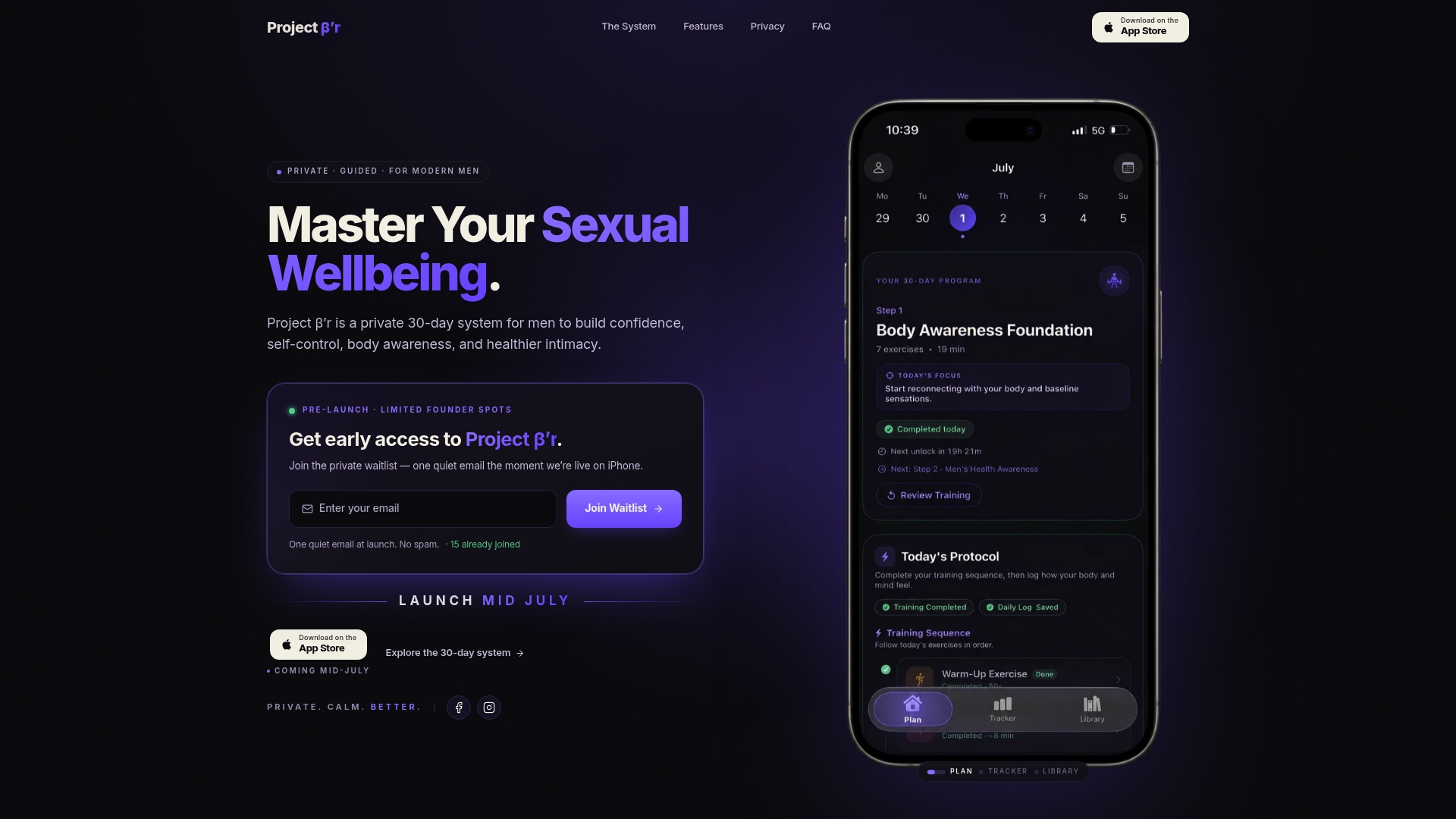
Projectbetter is a private 30-day program built specifically for men navigating these challenges. The structured daily protocols include movement exercises, guided pelvic floor training, mood and habit logging, and self-reflection tools designed to build the kind of calm self-awareness that makes genuine intimacy possible. It is not a quick fix. It is a structured, evidence-based system that addresses the physical and psychological foundations of sexual confidence and relational presence.
The program also includes educational content on sexual health, guided audio meditations, and a library of repeatable exercises. For couples working through the practices in this article, Projectbetter’s intimacy exercises guide offers a practical companion resource. Private. Calm. Better.
Key Takeaways
Building intimacy in couples requires consistent, small acts across emotional, physical, cognitive, and experiential dimensions, not occasional grand gestures.
| Point | Details |
|---|---|
| Intimacy spans four dimensions | Emotional, physical, cognitive, and experiential connection each feed the others; neglecting one erodes the rest. |
| Turn toward bids consistently | Couples who stay together respond to each other’s bids for connection 86% of the time, while couples who divorced responded only 33% of the time, per Gottman’s research. |
| Daily rituals buffer stress | Recurring habits like phone-free check-ins maintain positive sentiment and reduce conflict over time. |
| Relinquishing control builds trust | Control attempts are fear-based and create distance; letting go opens space for mutual responsibility and closeness. |
| Projectbetter supports men’s foundation | The 30-day program builds nervous system regulation and self-awareness, the internal groundwork for deeper relational intimacy. |
The part most couples skip
Most couples approach intimacy as a cognitive problem. They read articles, have the conversation, agree to try harder, and then wonder why nothing changes. The reason is that intimacy is not primarily a thinking problem. It is a nervous system problem. Two people can understand everything in this article and still be unable to access closeness if their bodies are registering the relationship as a source of threat rather than safety.
The sequence the nervous system demands is non-negotiable: safety first, then connection. You cannot negotiate your way to vulnerability. You cannot schedule your way to desire. What you can do is create the conditions, through proximity, stillness, consistent non-sexual touch, and the gradual accumulation of moments where disclosure was met with care, that allow the nervous system to reclassify the relationship as safe.
The other thing couples skip is the internal work. Particularly for men, the pressure to perform, to have it together, to not need anything, runs deep. That pressure does not disappear at the bedroom door. It shows up as emotional unavailability, as control, as the inability to stay present when things get vulnerable. Addressing it is not weakness. It is the most direct route to the kind of intimacy both partners actually want.
FAQ
What are the most effective ways to increase intimacy in a relationship?
The most effective approaches combine daily non-sexual touch, turning toward your partner’s bids for connection, and practicing small acts of vulnerability consistently. Gottman’s research shows that couples who stay together turn toward bids for connection 86% of the time, while couples who divorce do so only 33% of the time; this difference is a strong predictor of lasting intimacy.
How long does it take to rebuild intimacy after a period of distance?
Noticeable improvements in emotional closeness often appear within weeks of intentional, consistent effort. Deep intimacy is an ongoing practice, not a destination reached once and maintained automatically.
How does past trauma affect intimacy in couples?
Trauma teaches the nervous system that vulnerability is dangerous, which can cause emotional shutdown or withdrawal during moments of closeness. Gradual, repeated experiences of safe disclosure, sometimes supported by a trauma-informed therapist, are the most reliable path forward.
What role does control play in intimacy problems?
Attempting to manage a partner’s choices sends the message that you know better than they do, which creates distance and erodes trust. Relinquishing inappropriate control is one of the most direct ways to open space for genuine closeness and mutual responsibility.
How does Projectbetter help men build intimacy?
Projectbetter’s 30-day program addresses the internal foundations of intimacy: nervous system regulation, self-awareness, and sexual confidence. These are the conditions that allow men to be genuinely present and emotionally available in their relationships.