Best Sexual Wellness App Alternatives to Try in 2026
TL;DR:
- The top sexual wellness app alternatives in 2026 address needs like education, relationship building, and discreet health management. Many focus on privacy, evidence-based content, and specific audiences such as women, couples, or men. Projectbetter offers a private 30-day program designed specifically for men’s confidence and self-control.
What are the top sexual wellness app alternatives right now?
The best sexual wellness app alternatives in 2026 cover a wide range of needs: pleasure education, couples’ connection, men’s confidence, mindfulness, and discreet sexual health management. Here is a clear overview of the leading options, organized by focus and audience.
- Emjoy — Audio-guided pleasure education for women. iOS and Android. Subscription-based with a free trial. Best for individuals seeking body awareness through mindfulness audio.
- Kama — Inclusive sexual health education with community features. iOS and Android. Free and premium tiers. Best for users wanting expert-led content alongside social engagement.
- Paired — Daily quizzes, relationship challenges, and communication tools for couples. iOS and Android. Subscription with free access. Best for couples deepening their connection.
- Coral — Privacy-first app with encrypted partner chat and AI-driven insights. iOS and Android. Subscription-based. Best for users who prioritize discreet communication.
- Aurore — Guided audio and video sessions blending mindfulness with empowerment. iOS. Subscription-based. Best for personalized self-care and pleasure guidance.
- Ferly — Mindfulness-based pleasure coaching with guided meditations. iOS and Android. Free trial plus subscription. Best for stress reduction and body-aware sexuality.
- Rosy — Sexual health app tailored to women, with education and community support. iOS and Android. Subscription with free content. Best for women exploring pleasure and wellness.
- Lover App — Expert-backed intimacy exercises and tracking for couples. iOS and Android. Subscription-based. Best for couples wanting structured, research-informed tools.
- OMGYes — Research-based interactive video teaching women’s pleasure techniques. Web and iOS. One-time purchase per season. Best for evidence-backed pleasure education.
- The Sex Ed — Broad sex education covering anatomy, consent, and relationships. Web and iOS. Free and premium content. Best for inclusive, wide-ranging education.
- Blueheart — Therapy-inspired couples’ app with structured intimacy activities. iOS and Android. Subscription-based. Best for couples seeking clinical-grade support.
- We-Vibe — App synchronized with smart devices for personalized pleasure feedback. iOS and Android. Free with device purchase. Best for users integrating smart vibrators.
- Desire — Gamified couples’ challenge app designed to increase passion. iOS and Android. Subscription with free tier. Best for couples wanting playful intimacy games.
- Dipsea — Audio erotic stories and guided sessions for arousal and intimacy. iOS and Android. Subscription-based. Best for sensual storytelling and solo or partnered exploration.
A closer look at what makes each app different
Not every sexual wellbeing app is built the same. The differences in features, privacy, and audience fit matter more than most people realize before they download.
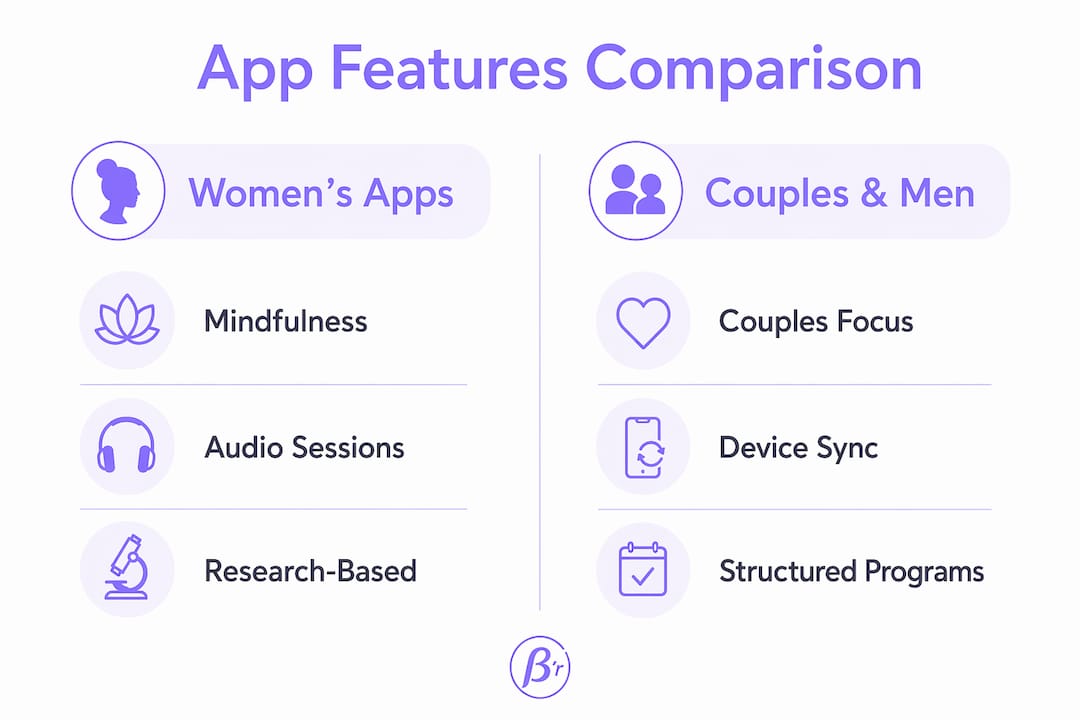
Emjoy and Ferly share a mindfulness-first philosophy, but their execution differs. Emjoy centers on audio sessions that guide listeners through body awareness and pleasure, while Ferly leans into guided meditations specifically targeting sexual stress and confidence. Both suit people who want a calm, private space rather than a content library to scroll through.
Paired, Lover App, Blueheart, and Desire all serve couples, but with distinct approaches. Paired focuses on daily micro-habits: short quizzes and prompts that build communication over time. Lover App adds expert-led video exercises and tracks intimacy patterns. Blueheart takes the most clinical angle, drawing on sensate focus therapy to help couples rebuild physical closeness. Desire is the lightest of the four, using gamified challenges and dares to reignite playfulness rather than deepen emotional processing.
Coral stands out for its privacy architecture. The app uses encrypted data storage and anonymous partner communication tools, making it one of the few apps where discreet STI status management is a core feature rather than an afterthought. Users who value keeping their sexual health data genuinely private will find Coral’s design intentional in a way most apps are not.
OMGYes occupies a category of its own. Built on original research into women’s pleasure, it uses interactive video demonstrations rather than passive content. There is no subscription loop: users pay once per season of content. The research foundation is real, drawing on survey data from thousands of women to identify specific techniques that work.
Rosy and Kama both address women’s and LGBTQ+ sexual health, but Rosy focuses more on individual empowerment and guided exploration, while Kama integrates community features so users can engage with others navigating similar questions. The Sex Ed takes the broadest view, covering anatomy, consent, and relationship dynamics in a format that suits curious adults at any stage.
We-Vibe is the only app on this list that requires a paired device. The app syncs with We-Vibe smart vibrators and uses biofeedback to personalize the experience, similar to how the Lioness app pairs with its massager to deliver AI-driven session analytics. Both represent the device-integrated end of the sexual wellness spectrum.
Dipsea and Aurore both use audio as their primary medium, but Dipsea leans into erotic storytelling while Aurore blends guided sessions with empowerment content. Dipsea’s library is large and updated regularly; Aurore’s experience feels more structured and personal.
Pro Tip: Before committing to a subscription, check whether the app offers a genuine free trial with access to core features, not just an onboarding screen. OMGYes, Calypso, and several others let you sample real content before paying.
How sexual wellness apps actually improve intimacy and sexual health
The most effective apps in this category work through three overlapping mechanisms: education, mindfulness practice, and private communication tools.

Education is the foundation. Apps like OMGYes, The Sex Ed, and Kama deliver content grounded in research, covering everything from anatomy to communication skills. Regular engagement with evidence-based material builds a working knowledge of one’s own body and desires, which translates directly into more confident and satisfying experiences. The Calypso app, for example, structures its 25 lessons across five modules built on research from the Kinsey Institute, using spaced repetition to make the learning stick.
Mindfulness practice is where apps like Ferly, Emjoy, and Aurore add something distinct. Guided audio sessions reduce performance anxiety by shifting attention from outcome to sensation. This is not a soft benefit. Anxiety is one of the most common barriers to sexual satisfaction, and structured breathing and body-scan exercises address it directly.
Privacy tools enable a different kind of benefit: responsible, stigma-free sexual health management. Anonymous partner notifications and encrypted data storage, as seen in Coral and apps like KISS, let users manage STI status and communicate with partners without fear of exposure. Research confirms that users value this “discreet control” precisely because it removes the social shame that often delays action on sexual health concerns.
Some apps also serve as a bridge to professional care. Platforms like Unna by Unprude use AI-based referrals to connect users with verified therapists and doctors when the app’s content is not enough. This positions sexual wellness apps not as replacements for clinical care, but as a lower-barrier first step toward it.
Pro Tip: Use an app’s guided sessions consistently for at least three weeks before evaluating whether it’s working. Most mindfulness-based benefits build gradually, not after a single session.
How to choose the right sexual wellness app for your needs
The right app depends on what you are actually trying to address. A few clear questions narrow the field quickly.
- What is your primary goal? Pleasure education, couples’ connection, men’s confidence, mindfulness, or discreet health management each point to different apps. OMGYes and Ferly suit education and body awareness; Paired and Blueheart suit couples; Projectbetter suits men working on confidence and self-control.
- Who is the app built for? Most apps skew toward women or couples. If you are a man looking for a program designed specifically around male sexual health, the options narrow considerably. Check whether the content, exercises, and framing actually address your experience.
- How private does it need to be? If data security matters to you, look for apps that explicitly state they use encryption and avoid selling personal data. Coral and KISS are built around this; others are less transparent.
- What platform do you use? Most top apps are available on both iOS and Android, but a few (Aurore, OMGYes) have limited web or iOS-only access. Confirm compatibility before subscribing.
- What is your budget? Pricing ranges from free tiers to $10–$15 per month for premium access. OMGYes uses a one-time purchase model. Femia offers premium plans from $5 per month. Calypso’s annual plan is $49.99 per year with a 7-day free trial.
- Is the content expert-backed? Look for apps that name their research sources or the professionals involved in content creation. Vague claims of “expert-designed” content without specifics are a warning sign.
Pro Tip: Read recent user reviews on the App Store or Google Play, filtered to the last 90 days. App quality changes with updates, and recent reviews reflect the current experience far better than an overall rating.
Projectbetter: a private 30-day program built specifically for men
Most sexual wellness apps are designed with women or couples as the primary audience. Projectbetter takes a different approach: a structured, private 30-day program built specifically for men who want to address performance pressure, impulsive habits, and low sexual confidence.
The program runs through daily protocols that combine movement exercises, guided pelvic floor (Kegel) training, audio meditations, and self-reflection tools. Each day builds on the last. The structure is intentional: gradual, consistent progress rather than a content library you browse when you feel like it. Men who have struggled with building sexual confidence often find that an unstructured app does not create the accountability they need.
Privacy is built into the design. The app does not require social features, public profiles, or community participation. Your data stays yours. The framing throughout is calm and judgment-free, which matters when the topics being addressed carry real personal weight.
The evidence base draws on research into pelvic floor function, mindfulness, and habit formation. Mood and habit logging, progress tracking, and a library of repeatable exercises give users a clear picture of where they started and how far they have come. For men dealing with decreased libido or self-control challenges, that visibility is part of what makes the program work.
Projectbetter offers a structured path when other apps fall short
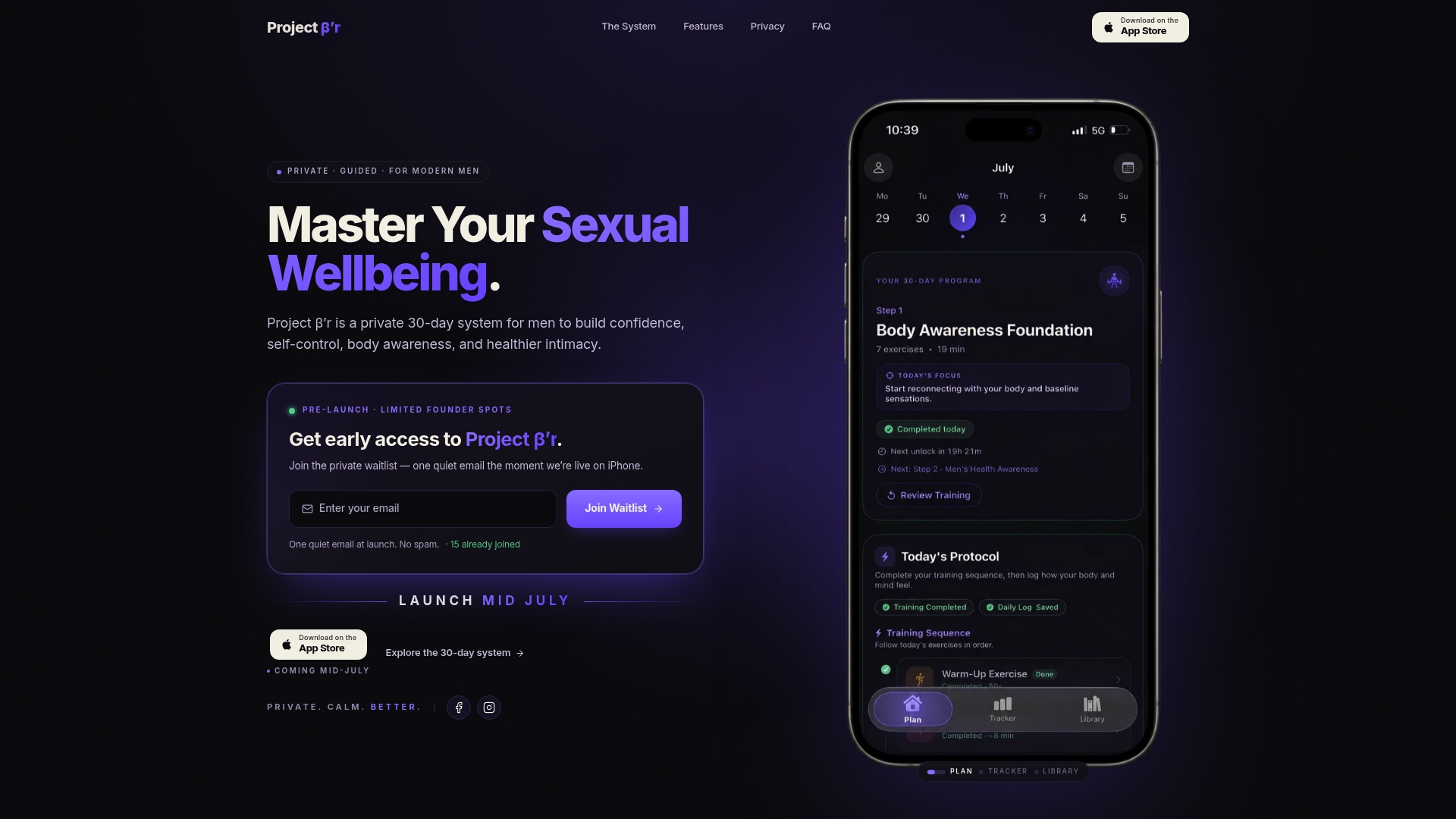
If you have browsed the apps on this list and found that most of them were not built with you in mind, that is a fair observation. The majority of sexual wellness apps focus on women’s pleasure, couples’ games, or broad education. Projectbetter is a different kind of option: a private, 30-day men’s program that addresses the specific pressures men face around sexual confidence, self-control, and intimacy.
The program is available on iOS with flexible subscription plans, including a free trial, weekly, monthly, and annual options. Daily protocols take minutes, not hours, and the progress tracking keeps you grounded in what is actually changing. No social feed. No public profile. Just a private space to work on something that matters.
Key Takeaways
The most effective sexual wellness app alternatives match a specific goal, audience, and privacy need rather than trying to serve everyone at once.
| Point | Details |
|---|---|
| Match app to goal | Couples, women, and men each have distinct apps built for their needs; generic picks often underdeliver. |
| Privacy varies widely | Only a few apps, like Coral and KISS, use encrypted storage and anonymous partner notifications by design. |
| Pricing models differ | Options range from free tiers to one-time purchases (OMGYes) to annual plans like Calypso at $49.99/year. |
| Expert backing matters | Look for apps citing named research sources, such as the Kinsey Institute, rather than vague “expert-designed” claims. |
| Projectbetter for men | Projectbetter’s 30-day structured program addresses male sexual confidence, pelvic floor training, and self-control in a private and supportive environment. |
FAQ
Which sexual wellness app is best for men?
Most top-rated sexual health apps focus on women or couples. Projectbetter is designed specifically for men, offering a private 30-day program with pelvic floor training, guided reflections, and habit tracking.
Are sexual wellness apps private and secure?
Privacy varies by app. Coral and KISS use encrypted data storage and anonymous partner notifications, while many other apps are less explicit about their data practices.
Do sexual wellness apps replace therapy or medical care?
No. These apps complement professional care rather than replace it. Some platforms, like Unna by Unprude, include AI-based referrals to verified therapists and doctors when users need deeper support.
What is the most research-backed sexual wellness app?
OMGYes is built on original survey research into women’s pleasure techniques. Calypso draws on findings from the Kinsey Institute and researchers like Dr. Emily Nagoski. Both are among the most evidence-grounded options available.
How much do sexual wellness apps cost?
Pricing ranges widely. Femia’s premium plan starts at $5 per month, Calypso’s annual plan is $49.99 per year with a 7-day free trial, and OMGYes uses a one-time purchase model per content season.