Best Mood Logging Apps in 2026: Expert-Tested Guide
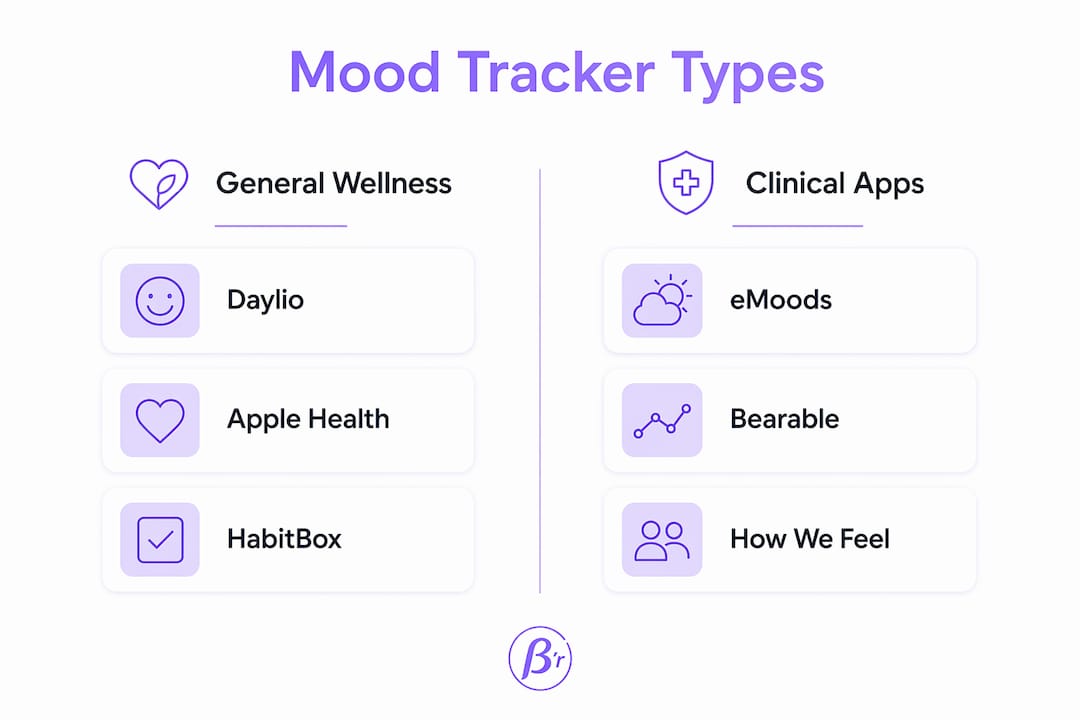
The best mood logging apps in 2026 are Daylio, Bearable, eMoods, Moodflow, How We Feel, Apple Health (State of Mind), and HabitBox. Each serves a distinct need: Daylio leads for general journaling, eMoods for clinical use, Bearable for complex symptom tracking, and Apple Health (State of Mind) for iOS users who want zero setup. Therapists consistently recommend apps that combine low-friction logging with data export, since the ability to share mood trends with a provider can meaningfully shape treatment decisions.
| App | Best for | Platform | Key features | Data privacy | Pricing model |
|---|---|---|---|---|---|
| Daylio | General mood journaling | iOS, Android | Customizable moods, activity tags, visual reports | Cloud sync, optional backup | Free; premium subscription |
| Bearable | Complex symptom tracking | iOS, Android | Correlations, notes, health metrics | Local + cloud, no data selling | Free; premium subscription |
| Moodflow | Quick logging with AI insights | iOS | Fast entry, plain-English AI analysis | Local storage option | Free; premium subscription |
| How We Feel | Social mood awareness | iOS, Android | Anonymous sharing, emotional timeline | Anonymized community data | Free |
| eMoods | Clinical and bipolar support | iOS, Android | Medication log, sleep tracking, PDF reports | Encrypted, HIPAA-aware | Free; premium subscription |
| Apple Health (State of Mind) | iOS ecosystem users | iOS only | Native integration, mood adjectives, trends | On-device, Apple ecosystem | Free (built-in iOS 17+) |
| HabitBox | Habit and mood combined | iOS, Android | Streaks, reminders, gamified habits | Cloud sync | Free; premium subscription |
Apple Health (State of Mind), introduced in iOS 17, stands out as the only fully free, no-download option for iPhone users. For anyone managing a diagnosed mood disorder, eMoods and Bearable offer the most clinically useful data, including printable PDF reports that simplify conversations with therapists.
What makes mood logging apps different from each other?
The gap between a basic mood app and a genuinely useful one comes down to three things: how fast you can log, how much context the app captures, and what it does with that data afterward.
Daylio and Moodflow both prioritize speed. Daylio uses a tap-and-tag system where you select a mood icon and check off activities in under thirty seconds. Moodflow goes further by adding AI-driven plain-English summaries that connect your entries to patterns over time, which many users find more motivating than raw charts. Both offer free basic plans with premium tiers unlocking deeper history and export.

Bearable sits at the other end of the spectrum. It lets you track dozens of variables simultaneously: mood, energy, sleep quality, symptoms, medications, and custom tags. The correlation engine then surfaces relationships you might never notice manually, such as how two nights of poor sleep reliably precede a low-mood day. That depth makes it the strongest general-purpose option for anyone managing a chronic condition without needing a fully clinical app.

How We Feel takes a different angle entirely. Built with input from mental health researchers, it focuses on emotional vocabulary and anonymous community sharing. You log how you feel using a rich set of descriptors, and the app shows you how your emotional state compares to others in your region or age group. It’s free, with no premium tier, which makes it accessible but also limits advanced personal analytics.
HabitBox blends mood awareness with habit formation through streaks and gamified reminders. If your goal is building consistent daily check-ins rather than deep clinical analysis, its structure works well. The gamification keeps early engagement high, though some users find the habit-first framing less suited to serious mental health tracking.
Clinical apps: eMoods and what sets it apart
eMoods was built specifically for people managing bipolar disorder, depression, PTSD, and anxiety. Every logging screen reflects clinical priorities: you track mood elevation and depression separately, log sleep hours, note irritability, and record medications and their effects. At the end of a month, the app generates a structured PDF report formatted for psychiatrists and therapists, reducing the cognitive load of trying to recall a month’s worth of symptoms during a fifteen-minute appointment.
That clinical focus comes with a trade-off. eMoods is less flexible for general wellness tracking and its interface feels more utilitarian than Daylio or Moodflow. For someone without a diagnosed condition, it may feel like overkill. For someone who sees a prescriber regularly, it can be the most practically valuable app on this list.
Apple Health (State of Mind): the built-in option
Apple’s State of Mind feature, available on iPhone and Apple Watch since iOS 17, logs both momentary emotions and overall daily feelings using a set of customizable mood adjectives. Because it lives inside the Health app, it syncs across Apple devices automatically and feeds into the broader health dashboard alongside sleep, activity, and heart rate data. There’s no separate download, no subscription, and no account to create.
The limitation is platform lock-in. Android users have no access, and the feature doesn’t generate clinical reports or offer the correlation depth of Bearable. For iOS users who want a low-commitment starting point, though, it’s genuinely hard to beat.
How do you choose the right mood tracking app for your needs?
The right app depends on why you’re tracking in the first place. A few honest questions narrow the field quickly.
Are you tracking for clinical or therapeutic purposes? If you see a therapist, psychiatrist, or prescriber regularly, prioritize apps that export data. eMoods and Bearable both generate reports you can share directly. Exporting mood data as a PDF removes the guesswork from clinical appointments and gives your provider objective patterns rather than your memory of the past month.
How much time will you realistically spend logging each day? Consistency matters more than completeness. An app you use for thirty seconds daily produces better data than one you abandon after a week because it takes five minutes. Daylio and Moodflow are built for speed. Bearable rewards users who invest more time but can feel burdensome if you’re already stretched.
Do you need privacy above everything else? Data privacy in mental health apps is a genuine concern. Emotional records are among the most sensitive data you can store. Apple Health keeps everything on-device by default. eMoods and Bearable offer local storage options. Before committing to any app, check whether your data is sold to third parties or used for advertising.
Are you managing a specific condition or tracking general wellness? General wellness users typically do well with Daylio, Moodflow, or HabitBox. People managing bipolar disorder, PTSD, or treatment-resistant depression get more value from eMoods or Bearable, where the logging structure mirrors clinical assessment frameworks.
Here’s a practical checklist for making your final decision:
- Does the app let you log in under sixty seconds on a bad day?
- Can you export your data as a PDF or CSV for a provider?
- Does the privacy policy clearly state your data is not sold?
- Does it track the specific variables that matter to your situation (sleep, medications, energy)?
- Does it offer reminders you can schedule without them becoming annoying?
- Is there a free tier that lets you test it for at least two weeks before paying?
Pro Tip: Start with the simplest app that covers your core need. After two weeks of consistent logging, you’ll know whether you need more depth. Upgrading from Daylio to Bearable is easy; switching mid-stream and losing your history is frustrating.
Who benefits most from daily mood tracking?
Mood tracking apps convert subjective feelings into patterns you can actually act on. That shift from vague awareness to concrete data is where the real value lies, and it shows up differently depending on who’s using the app.
People managing bipolar disorder gain the most from structured daily logging. Mood episodes rarely arrive without warning signs, but those signs are easy to miss in the moment. An app that logs sleep, energy, and irritability alongside mood creates a visible record of the days before an episode, which both the person and their provider can use to intervene earlier. eMoods was designed with exactly this use case in mind.
Those in active therapy benefit from having objective data to bring to sessions. Therapists frequently note that clients struggle to recall how they felt two weeks ago, especially when their current mood colors the memory. A logged record removes that distortion. Apps like Bearable and eMoods make this straightforward with their export features.
Research published in mobile mood tracking analysis found that mood tracking apps vary widely in their clinical utility, with the most effective ones combining contextual logging (sleep, activity, social interaction) with structured reflection prompts.
People managing anxiety, PTSD, or depression also find mood tracking useful for identifying triggers. Logging what happened before a difficult emotional state, not just the state itself, builds a map of personal patterns over time. That map is something a therapist can work with directly.
General wellness users, people without a diagnosed condition who simply want more self-awareness, benefit from apps like Daylio, Moodflow, or HabitBox. The gains here are subtler but real: better understanding of how sleep, exercise, and social contact affect your daily mood, and a growing sense of agency over your emotional life.
What features should you look for in a mood tracking app?
Most mood tracking apps share a core set of features, but the differences between them are where the real choices live.
Standard features across most apps:
- Mood rating scales (numeric, emoji, or descriptive)
- Activity and tag logging to add context to mood entries
- Daily or scheduled reminders
- Trend charts and weekly or monthly summaries
- Notes or free-text journaling fields
Features that separate good apps from great ones:
- Ecological momentary assessment (EMA): prompting multiple mood entries per day.pdf) reduces recall bias and produces more accurate data than a single end-of-day log. Moodflow and Bearable both support this.
- Correlation analysis: Bearable automatically surfaces relationships between tracked variables, such as the link between alcohol consumption and next-day mood.
- Medication and symptom logging: eMoods includes dedicated fields for medication doses and side effects, which most general apps omit.
- AI-driven insights: Moodflow’s plain-English analysis translates raw data into readable summaries without requiring the user to interpret charts.
- Apple Health integration: apps that sync with Apple Health can pull in sleep and activity data automatically, reducing manual entry.
- Local data storage: apps that store data on-device rather than in the cloud offer stronger privacy protections for sensitive records.
- PDF export: critical for clinical users who need to share data with providers.
- Customizable mood tags: the ability to create your own mood labels and activity categories increases relevance and long-term engagement.
One feature worth watching in 2026 is cycle-aware mood tracking, where apps account for hormonal patterns as a variable in mood analysis. This is still emerging in mainstream apps but represents a meaningful step toward more personalized emotional data.
For men specifically, apps that connect mood to physical health variables like sleep quality, exercise frequency, and energy levels tend to produce the most useful patterns. The connection between physical state and emotional state is direct, and tracking both together reveals it clearly.
How do you build a consistent mood logging habit?
Consistent mood logging is harder than it sounds. Most people start with good intentions and stop within two weeks. The barrier isn’t motivation. It’s friction.
The apps with the highest long-term retention are the ones that make logging feel effortless. A single tap to select a mood, two taps to add an activity, done. Daylio was built around this principle. When the entry takes longer than a minute, it starts competing with everything else in your day, and most days, it loses. Keeping the interface simple isn’t a design compromise. It’s the feature that determines whether you’ll have any data worth analyzing in three months.
Active reflection is the other half of the equation. Logging without reviewing is like taking notes you never read. Setting aside five minutes once a week to look at your mood chart, notice any patterns, and connect them to what was happening in your life that week turns raw data into genuine self-knowledge. This is where apps like Bearable and Moodflow earn their value: the correlation tools and AI summaries do the analytical work so your reflection time stays focused on meaning, not math.
Pro Tip: Set your logging reminder for a time you’re already stationary: right after your morning coffee, before you plug in your phone at night, or immediately after lunch. Attaching the habit to an existing anchor point dramatically increases follow-through.
Here’s what the research and clinical practice consistently support for building a lasting logging habit:
- Log at the same time each day for the first three weeks to build the anchor
- Use a reminder that fires at a moment of low cognitive load
- Review your data weekly, not just daily, to see patterns emerge
- Start with mood and one or two context tags; add more variables only after the habit is solid
- Choose an app whose interface you genuinely like looking at, since aesthetic friction is real
Privacy also plays a role in sustained use. Knowing your emotional records are stored securely, not shared with advertisers or third parties, removes a subtle but real psychological barrier to honest logging. Apps that are transparent about their data security practices tend to earn more consistent engagement from users who take their mental health seriously.
For men in particular, the private nature of mood logging matters. There’s still a cultural reluctance around tracking and discussing emotional states openly. An app that keeps your data entirely to yourself, with no social features you didn’t ask for, lowers that barrier considerably. If you’re also exploring how mood connects to physical wellbeing, energy, and confidence, a more structured program may offer more than a standalone app.
Projectbetter: mood and habit tracking built for men’s wellbeing
Most mood logging apps are built for broad audiences. Projectbetter takes a narrower, more focused approach: a private 30-day iOS program designed specifically for men who want to understand the connection between their emotional state, physical habits, and sexual confidence.
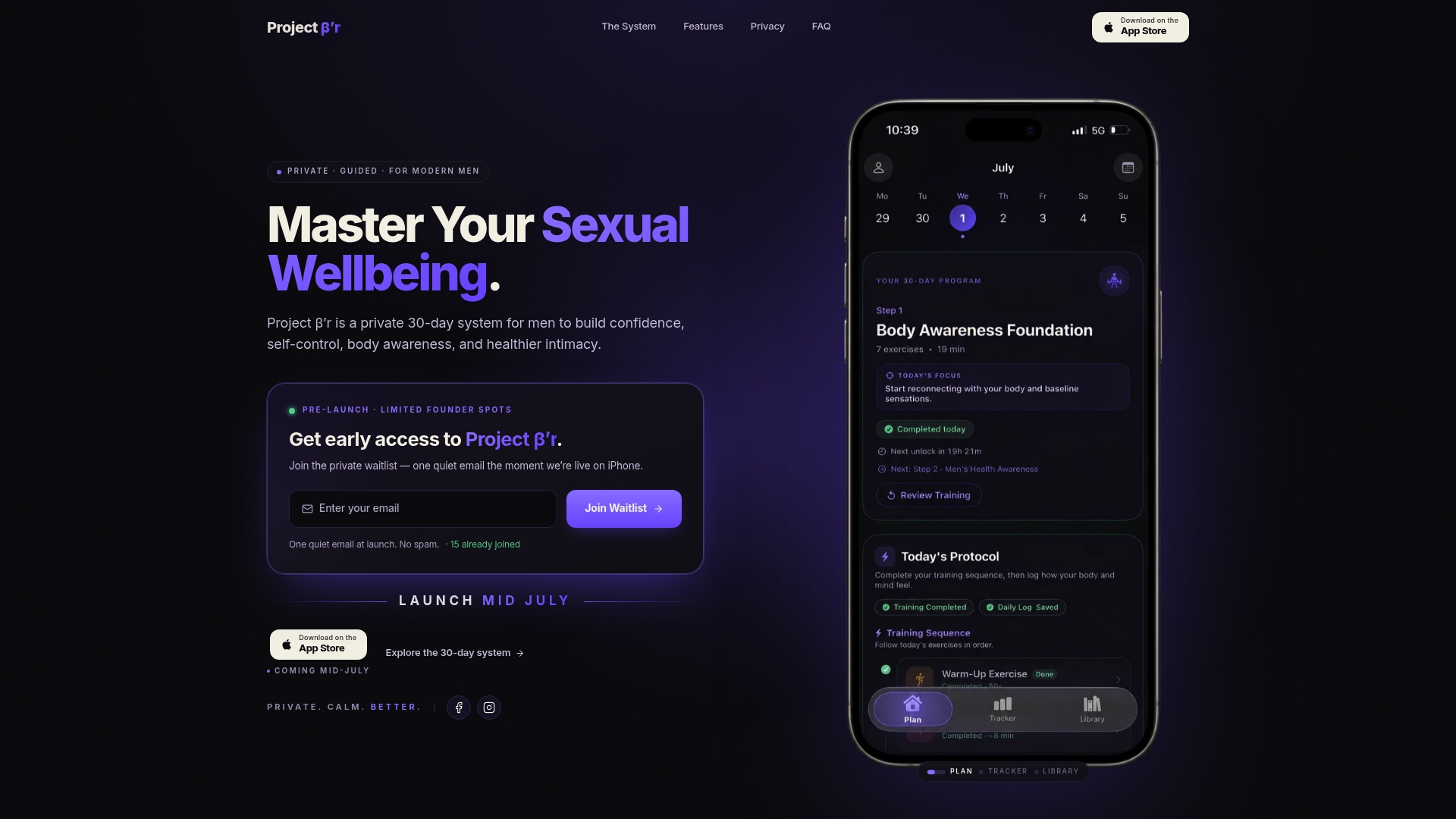
Where general apps track mood in isolation. Projectbetter integrates daily mood and habit logging into a structured program that also includes pelvic floor (Kegel) training, guided audio meditations, movement exercises, and self-reflection tools. The mood tracking here isn’t a standalone feature. It’s part of a daily protocol designed to show you how your habits, energy, and emotional state interact over time. That context makes the data more meaningful than a mood chart alone.
The program is private by design. No social features, no community feed, no data shared with third parties. Everything stays between you and the app. For men who want to work on performance pressure, impulsive habits, or low sexual confidence in a calm, structured environment, Projectbetter offers a path that general mood apps simply aren’t built for. It’s available on iOS with a free trial and flexible subscription plans (weekly, monthly, and annual). If you’re ready to connect your emotional awareness to real physical and relational progress, explore Projectbetter and see whether the 30-day structure fits where you are right now.
Key Takeaways
The most effective mood tracking app is the one you’ll actually use every day, chosen based on your clinical needs, privacy requirements, and how much time you can realistically commit to logging.
| Point | Details |
|---|---|
| Match app to purpose | Clinical users need eMoods or Bearable; general wellness users do well with Daylio or Moodflow. |
| Privacy is a core feature | Apps with local storage and clear no-sell policies protect sensitive emotional data. |
| Consistency beats completeness | Consistent daily logging beats a detailed weekly one for building reliable mood patterns. |
| EMA reduces recall bias | Multiple daily prompts produce more accurate mood data than a single end-of-day entry. |
| Projectbetter for men | Projectbetter integrates mood logging into a structured 30-day program connecting emotional and physical wellbeing. |
FAQ
What is the best mood tracker for bipolar disorder?
eMoods is the most clinically focused option for bipolar disorder, offering separate tracking for mood elevation and depression, medication logging, sleep data, and printable PDF reports formatted for psychiatrists. Bearable is a strong alternative for users who want broader symptom correlation alongside mood.
Are mood tracker apps actually effective?
Research supports their effectiveness when used consistently, particularly apps that log contextual data like sleep and activity alongside mood. Mobile mood tracking studies show the most useful apps combine contextual logging with structured reflection prompts, not just mood ratings alone.
Does the iPhone have a built-in mood tracker?
Yes. Apple introduced the State of Mind feature in iOS 17 within the Health app, allowing users to log momentary emotions and daily feelings using customizable mood adjectives. It syncs across iPhone and Apple Watch and requires no separate download or subscription.
What is the best way to track mood daily?
Log at the same time each day using an app with a fast, low-friction interface, and review your data weekly rather than just daily. Adding one or two context tags (sleep quality, exercise, social contact) alongside your mood rating produces patterns that are far more useful than mood scores alone.
Which mood tracking app works best for men?
General apps like Daylio work well for habit-building and pattern awareness. For men who want mood tracking connected to physical health, energy, and confidence, Projectbetter integrates daily mood and habit logging into a structured 30-day program built specifically around men’s wellbeing.